



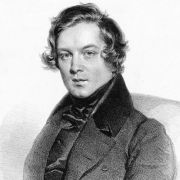


Within the canon of acknowledged great composers, Robert Schumann is unique in being the only one to have written novels before embarking on his career as composer. Although he never became a great novelist, he did become a highly influential music critic who started his own musical journal.
There are many definitions of exactly what constitutes “Romantic” classical music. By just about any definition, whether based on form, tonality, theme or mood, Schumann is one of the composers who epitomises it. His character was depressive (he might today be labelled “bipolar”), lurching between extremes of joy and despondency, contrasts that are reflected in his music. But whichever the extreme, Schumann’s music is always of great beauty. It’s music which is easy to listen to, instilling its mood gently, subtly and harmoniously, even in its faster, louder or more vivacious passages.
Schumann was one of the first composers to make extensive use of “programme music” in which the music explicitly describes characters or scenes. He even invented characters to embody the opposite halves of his own personality: “Florestan” represents his more violent, passionate side, while “Eusebius” displays his introspective and distant side. Both Florestan and Eusebius appear frequently in his writing, and each appears as a movement of the piano suite Carnaval, a collection showing great variety and colour and one of Schumann’s best loved works. Throughout his output, Schumann makes extensive use of German romantic themes - the journey through the forest, the young woman taking holy orders at the cathedral gate while her lover watches silently, the traveller’s rest in a wild, stormy night, and many others.
Perhaps the work that best illustrates Schumann’s delicacy and subtlety is Kinderszenen (scenes from childhood), a set of thirteen piano pieces that beautifully portray the gentle, wide-eyed innocence of childhood, appealing both to a novice classical music listener and to any expert who, perhaps jaded by more complex or overwrought fare, will find a rare combination of beauty and economy of expression.
Schumann is probably best remembered for his piano works (as well as Kinderszenen and Carnaval, his Kreisleriana, Papillons and fantasies are much performed and recorded, as well as the A minor Piano Concerto) but he mastered many forms of composition. His symphonies are still frequently played and his chamber music contains several standards of the repertoire, most notably the Piano Quintet and the three Fantasiestücke for Clarinet and Piano. The single opera, Genoveva, remains an obscure curiosity. Unusually, he seems to have worked at the different musical forms in phases, devoting a few years of his life to each form.
In 1840, Schumann married Clara Wieck, the daughter of his music teacher (who disapproved of the match and made all possible efforts to prevent it) and a historically important pianist in her own right. The marriage was a very happy one: in that year, Schumann wrote no fewer than 168 songs, leading scholars to describe it as the “Year of the Lied”.
Schumann formulated his own set of musical “house and life rules”, which set out his view of how an aspiring musician should approach his art. They show the constant struggle between a man of vivid temperament and imagination and a meticulous believer in order, structure and hard work. To describe his music, one can do little better than to use his own words:
If you have been given a vivid imagination from above, then you will often find yourself spending solitary hours sitting at the piano as if in a trance searching for harmonies to express your inner feelings. The more mysteriously you feel yourself drawn as if into a magic circle, the more elusive seems the world of harmony. These are the happiest hours of youth. But beware of surrendering to a talent that may lead you to waste time and energy on phantoms. The mastery of form, the power of clear arrangement, can be acquired only through the fixed symbols of notation. Therefore write more, and dream less.
David Karlin
22nd December 2009
| Geburtsjahr | 1810 |
| Sterbejahr | 1856 |
| Nationalität | Deutschland |
| Epoche | Romantik |