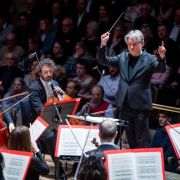
For Japanese people, summer is indelibly linked with the memory of the atomic bombings and defeat in the Second World War. In this 80th anniversary year since the conclusion of that war, Jonathan Nott’s decision to perform Benjamin Britten’s War Requiem as part of his final season as Music Director of the Tokyo Symphony Orchestra seemed both symbolic and poignant. Set to the words of the Latin Mass for the Dead and the poems of war poet Wilfred Owen, the relevance of Britten’s Requiem at this current time of world conflicts would have been in people’s minds as they gathered at the Muza Kawasaki Symphony Hall.

Although he had sung it as a chorister, this was Nott's first time conducting the work. How to arrange the various performing groups that constitute the War Requiem in this spiralling vineyard-style hall would have been one of the concerns as he prepared this momentous piece. In the event, he placed the Tokyo Symphony Chorus in the choir stalls and the solo soprano behind the ladies, the main orchestra to the left of the podium, the tenor, baritone and chamber orchestra to its right, and the children’s choir (The Little Singers of Tokyo) and harmonium offstage outside the door of the upper gallery. Unlike a performance in a cathedral or church, there was much more clarity to the orchestral sound, and the playing of the chamber group came across particularly vibrantly.


The opening began quietly, almost eerily, with the chorus remaining seated and chanting the words “Requiem aeternum” with muted emotion, followed by the anguished tenor solo. The Dies irae was appropriately dramatic, with bright and brilliant playing from the horns and brass and the precise singing of the chorus. German baritone Matthias Winckhler captured the dark colours in Bugles sang, accompanied by the chamber orchestra, whose playing brought out Britten’s inventive writing vividly. Russian soprano Galina Cheplakova was a little tentative at first – the distance of her position from the orchestra probably didn’t help – but her voice soared easily over the chorus in the Lacrimosa. The subsequent tenor solo, Move him into the sun, was sung by Welsh tenor Robert Lewis with touching lyricism.
Nott kept the music on the move with urgency and tension throughout, focusing on coordinating and balancing the various groups, and handling the transitions between the chorus sections and the tenor and baritone solos sensitively. Never one for sentimentality, he went attacca from one movement to the next, giving us little time to reflect or wallow in the “pity of war” (Owen's words which Britten quoted on the score’s title page).

In the Offertorium, the angelic voices of the children’s choir wafted from above, leading into the choral fugue and sinister tenor-baritone duet. Nott brought out a brilliant cathedral-like sonority in the soprano-led Sanctus, providing contrast with the sombre tenor-led Agnus Dei. In the Libera me, the chorus and the orchestra built to a stormy, nightmarish climax of almost unbearable intensity. Against this, Strange Meeting – a haunting song of reconciliation between enemy soldiers in death – was sung calmly yet with emotional depth by Lewis and Winkhler. The lullaby-like chorus finally brought some serenity and peace, if only momentarily.


This was a deeply committed performance by all involved, and the excellent Tokyo Symphony Chorus, who sang from memory (as they always do), deserve special mention. Furthermore, the performance testified to the strength of trust nurtured by Nott and the Tokyo Symphony Orchestra over the past twelve years. Together they delivered Britten’s message with vividness and contemporary resonance.