Murder, betrayal, love, poison, opulent palaces and long fur coats. More than one century after its debut, Giordano's Fedora wouldn’t seem out of place in an average afternoon TV schedule, side by side with an episode of Columbo. In an updated version of his 2016 production for the Royal Swedish Opera, director Christof Loy brought this melange of melodrama and crime fiction to the Deutsche Oper Berlin, with the help of conductor John Fiore and leads Vida Miknevičiūtė and Jonathan Tetelman. Quite the rarity especially outside of Italy, the opera piqued Germans’ well-documented love for Krimis.

A few drawn-out scenes aside, Fedora benefits from the network of intrigues that librettist Arturo Colautti adapted from the source material, a play by the same Victorien Sardou who penned Tosca. Add to this Giordano’s melodic skill, which sustains the plot and makes Fedora’s Russia almost unmistakably Italian, and you have an engaging, enjoyable end product.


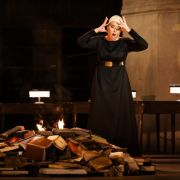
Loy’s staging renders a retro look reminiscent of film noir visual tropes but is ultimately eclectic. Herbert Murauer’s femme fatale costumes for Fedora hint at 1950s thrillers, while the rest draws from a pool of miscellaneous ‘vintage’ aesthetics. The same setting is maintained throughout all three acts – a narrow room on the forestage, whose luxurious damask wallpaper is contrasted by bare wooden pallets piled up in the back. A grand golden frame hanging from the backdrop expands the limited space, acting both as a screen for projections and as a door to an extra room behind the main one.
This extension is perhaps Loy’s most fortunate idea, as it allows different timelines to unfold at once. The projections are alternately synchronised with the stage or delayed, obfuscating the course of action and the distinction between past and present. In the second act, the frame becomes a window onto another room of Fedora’s Parisian home, separating the foreground, where Fedora and Loris have their moment of intimacy, from the background, where piano virtuoso Lazinski plays for the other guests. As the two soon-to-be lovers sing, the party in the other room occasionally freezes, juxtaposing a pictorial quality to the regular course of events. Pleasant overall, the staging is smudged by some coarse crowd movements which seem exaggerated even by verismo standards.

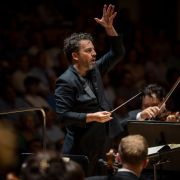
Conversely, Fiore bridled the bombastic potential of Giordano’s score for a sensible, convincing performance. If Fedora doesn’t reach the airtight quality of its cousin Tosca, it still stands the test of time, both musically and theatrically. Fiore took care of both aspects by indulging in the string-heavy lyrical abandonment only in moderation and always keeping a finger on the pulse of the drama. That Fiore is used to working with singers is clear from his way of providing stable support for the vocal lines, keeping tempi and dynamics consistent and letting the orchestra sing along. Good pacing in the more animated sections as well as in the placid build-up of the Intermezzo made the action concise and compelling. Overall, Fiore seemed at ease with this repertoire, whose timbral quirks – including the ever-reliable harp arpeggios and sweeping strings – require careful handling.


Vida Miknevičiūtė and Jonathan Tetelman have been working together for years and it shows. The two share a charming chemistry on stage, necessary for roles that often border on the over-the-top (who doesn’t keep a vial of poison in their necklace at the ready?!). For her debut as Fedora, Miknevičiūtė sang the part beautifully. Her soprano is resonant in the middle and low register, easy in the high notes, and characterised by a fast, fluttering vibrato that is delightful to the ear. No better choice to disprove the adage that verismo singing is little more than enhanced speaking.

Miknevičiūtė’s stage presence was matched by Tetelman’s. The tenor has sung the role before and his Loris is possibly all that Giordano and Colautti meant him to be – virile, passionate, impulsive – hardly a masterpiece of character-building. This goes all the more to Tetelman’s merit, who made the role believable through clear phrasing and a cannon of a tenor, well-projected and powerful in the high register and with a fitting pinch of heartache.
Julia Muzychenko and Navasard Hakobyan completed the cast as Countess Sukarev and De Siriex, respectively. The Russian soprano acted and sang with the correct ebullience, making for a light-hearted counterpart to Fedora. Hakobyan’s De Siriex sported a reliable, dark baritone, not huge in volume but appropriate for the character’s profile.