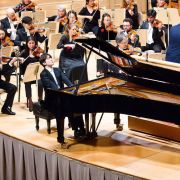
Sunday’s recital in Buttenwieser Hall at The 92nd Street Y, New York marked the end of a rare and demanding endeavour: a complete traversal of Schubert’s three song cycles over five days by baritone Konstantin Krimmel and pianist Ammiel Bushakevitz. Heard in sequence, Die schöne Müllerin, Winterreise and Schwanengesang offered an illuminating study in the composer’s evolving relationship to narrative, psychology and song form. The marathon also showcased these interpreters’ impressive ability to inhabit multiple poetic worlds with the same precision of line, attention to text and instinct for pacing.

Unlike Schubert’s two earlier cycles, Schwanengesang is a posthumous constellation of late songs from three poetic sources, whose stark shifts of mood and texture require a cohesion built through performance rather than narrative. Krimmel and Bushakevitz not only reordered the songs within each group but added four Seidl settings to the customary Die Taubenpost. This expansion gave the evening’s centre a gentler, more open-air character before turning to Heine’s darker poetry. In Sehnsucht, they let the music hover, the fine dynamic shadings suggesting longing without strain. Bei dir allein! emerged with conversational ease, its phrasing lifted by Bushakevitz’s discreet inflections. Der Wanderer an den Mond unfolded with an unhurried, reflective gait, Krimmel lightening his tone to match the poem’s modest scale. Das Zügenglöcklein was articulated with bell-like clarity, its phrasing attuned to the song’s oscillations of stillness and movement. Die Taubenpost carried a wistful brightness, its gentle circling motion shaped with an ease that let its quiet optimism register without sentimentality.


The seven Rellstab settings heard at the beginning of the performance invite a broader, more declarative manner, and Krimmel shaped them with elegance and a supple sense of motion. Ständchen, arguably the best-known song in Schwanengesang, showed his control of the slightest vocal modulation, from flowing legatos to the unexpected accent on “Busens” in “des Busens Sehnen”. In Abschied, the apparent merriness underlined by the piano’s staccatos was already tinged with longing before the switch to minor; each recurrence of the “Ade…” refrain carried a distinct inflection, as did the stanza-ending questions in Frühlingssehnsucht. Aufenthalt had a firmer edge, its turbulence conveyed through weight and precision, not sheer force. Placed last, Kriegers Ahnung was more firmly etched, its steady, funereal pulse giving it a contained tension, the final “Herzliebeste – gute Nacht” emerging with heartbreaking directness.
The Heine Lieder marked a decisive turn inward. Their compressed language and abrupt emotional pivots demand a different kind of focus, and Krimmel responded with sharpened diction and a more contained tone, while Bushakevitz drew a darker, more understated palette from the piano. Ihr Bild rested on a restrained, almost self-effacing accompaniment, its stark unison between voice and piano heightening the song’s suspended, dreamlike stillness. In Die Stadt, Bushakevitz’s slow-building swell established a foreboding atmosphere that Krimmel met with a steady delivery. His eerily still vocal approach conveyed Der Doppelgänger’s haunted confrontation with a chilling effect, the piano’s tolling sustaining the frozen tension. In the final song, Der Atlas, the anguish of the figure condemned to carry “the whole world of sorrow” was almost unbearable.


What impressed most in this recital was not only Krimmel’s command of nuance and Bushakevitz’s text-guided phrasing but the instinctive mutual understanding that shaped their still-young partnership. Even in the irregular, speech-derived rhythmic patterns that recur throughout the set, the two breathed and moved together with an ease that made every fluctuation feel like a natural extension of the underlying poem.
Attempting to dispel the gloom, the performers offered a single encore, far removed from Schubert’s world: a sunny, gently expansive reading of Vaughan Williams’s Silent Noon.