Partenope, Ennio Morricone’s only opera, finally reached the stage not as a historical curiosity but as a work that asks to be judged on its own terms. Written to a libretto by Guido Barbieri and Sandro Cappelletto and left unperformed for many years, it received its world premiere at the Teatro di San Carlo as part of the celebrations for the 2,500th anniversary of the founding of Naples. It is an opera that invites careful listening, without expectations and without indulgence.

Morricone’s musical language clearly belongs to the world of cultivated 20th-century music, with its use of modal counterpoint and controlled formal structures. The writing is austere and carefully shaped, often thoughtful rather than dramatic. This is Morricone as a “pure” composer, intellectually rigorous and technically assured, although at times the music seems to hold back from becoming fully urgent on a dramatic level. It develops through layers, timbral blocks and measured gestures, favouring reflection over momentum.


One of the most striking elements of the score is its orchestration. By excluding violins, Morricone distances the music from traditional operatic lyricism. Woodwinds, harps and a large percussion section create a dry, almost ritual sound world. Flutes suggest an archaic, suspended atmosphere, while violas, cellos and double basses provide a dark, grounded foundation. The percussion, including elements drawn from popular tradition, avoids any folkloric effect and instead acts as a primal pulse, echoing the physical memory of myth.

The music is often engaging, but it does not always feel fully necessary. The libretto, rich in symbols, shares the same emotional distance. Rather than building strong theatrical tension, it remains overly conceptual. The myth of Partenope is observed more than lived, and words and music sometimes seem to move alongside each other without fully connecting.
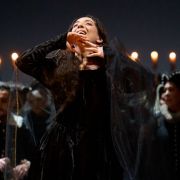
From a performance point of view, the cast appeared chosen to serve the overall vision rather than individual display. Jessica Pratt and Maria Agresta, in the shared roles of Partenope, faced vocal writing that avoids expansion and emotional release. Their declamation and singing were controlled and precise, focused on clarity of line rather than expressiveness. Their different timbres coexisted with composure, suggesting two aspects of the same figure rather than a dramatic contrast.

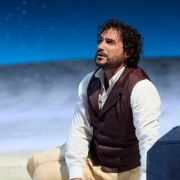
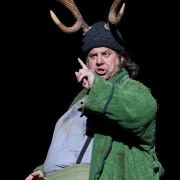
A stronger sense of human presence came from Mimmo Borrelli as narrator. His text, spoken in a dry and earthy Neapolitan dialect, did not celebrate the myth but looks at it with restrained surprise, as if aware of its weight rather than its glory. The secondary roles, sung by Désirée Giove (Persephone) and Francesco Demuro (Melanio), remain deliberately marginal. The women’s chorus, prepared by Fabrizio Cassi, performed with precision and balance, working closely with dancers and extras to form a collective presence that was symbolic as well as musical.


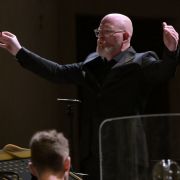
In the pit, Riccardo Frizza conducted the San Carlo Orchestra with clarity and restraint. His direction avoided adding drama where the score does not ask for it, accepting the reflective nature of the music and shaping it with care rather than emphasis.

The staging played a crucial role in the overall impact of the opera. Vanessa Beecroft’s production relies on strong visual images, carefully arranged bodies and controlled movement. The stage becomes a sequence of dramatically convincing tableaux, where themes of sacrifice, purity and descent into the underworld gain physical clarity, helping to fill the gaps left by the abstract dramaturgy.
This opera convinces more through intelligence and vision than through immediate emotional impact. It shows a side of Morricone far removed from the film music for which he is famous. He avoids easy solutions and emotional shortcuts, trusting the stage and the visual dimension to restore a sense of human presence that the music itself holds back. It is a demanding work, worth listening to with attention, and one that reveals both its strengths and its limits.