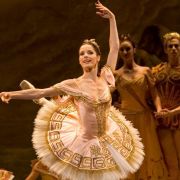
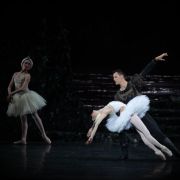
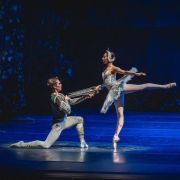
Although Ballet Black has been around for a quarter century, and I have not missed many of their shows, it still came as a surprise that this was the company’s debut at Sadler’s Wells, which has a solid claim to be London’s principal dance house. They are a company and venue that should now be regularly associated.

This double bill premiered earlier in the year, and one applauds the company’s appetite for continually showcasing new work. Although I think this programme fell short of the very best that the company has shown in the past, it was nonetheless a thoroughly enjoyable and diverse evening of dance.
First up was Chanel DaSilva’s A Shadow Work, a piece inspired from the intimate experience of the choreographer’s own therapeutic practice towards emotional healing. This was acheived through a technique based on theories of the Swiss psychotherapist, Carl Jung, which has something to do with the unification of our conscious and subconscious selves. I’m not clever enough to have worked this esoteric intent out for myself: I read about it in the programme because I was lucky enough to be given one. I don’t see why audience members should have to fork out for a programme in order to understand the intent of a piece.


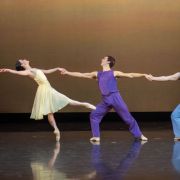
That said, as an abstract ballet it was commendable in many ways and contained the best pure dance of the evening. DaSilva’s autobiographical content revolved around the personal journey of a central woman in white (Taraja Hudson), beginning alone on stage and enjoying a long doleful solo before being joined by a group of dancers dressed in black, assumed to be the dark recesses of her subconscious. Again, thanks to the written notes, I learned that a central precept of the shadow self is an invisible bag into which we put the things that people don’t like about us. A portable cardboard box represented this theory but until I read the programme, I thought it had something to do with Pandora!

A deliberate lack of stage design was more than compensated by David Plater’s impressive lighting, creating strong focal points for the dancers (especially when there were simultaneous pools of action) and noir-style silhouettes on the back wall. As well as that opening solo, the most memorable dance came in a slow-burning pas de deux for Hudson and Acaoã de Castro.
At forty minutes, the work would have landed better with a substantial edit. As is often the case, the lack of a credit for dramaturgy was telling. The last ten minutes meandered and added quantity without enhancing quality.

Cassa Pancho has been one of the leading lights in British dance over the past 25 years and what she has done in establishing, nurturing and developing Ballet Black has been nothing short of miraculous. And even when one might have supposed the company to have attained security through its maturity, it found itself evicted from its home earlier this year, thus in some ways replicating the hand-to-mouth challenges of its formative period.
Pancho’s skill over the years has been to commission work from established choreographers as well as encouraging the craft from within, her greatest find being Mthuthuzeli November. It was only at the very beginning and recently that she has taken to making dance herself and in My Sister, The Serial Killer Pancho has demonstrated a shrewd choice of material, interpreting Oyinkan Braithwaite’s best-selling novel in her own highly stylish and personal way.


A week previously Sadler’s Wells had entertained dance theatre about sororicide by Michael Keegan-Dolan, whereupon an older sister killed her sibling but here the younger sister was addicted to bumping off her boyfriends and then calling her older sister, a caring nurse by profession, to don rubber gloves and help cover up her dirty deeds!
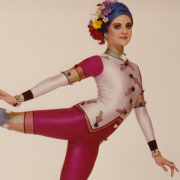
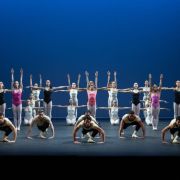
The work is elevated in many ways, through ingenuous prop use, effective lighting (Plater, again) and Jessica Cabassa’s eye-catching costumes, but especially in the tremendous performances of Helga Paris-Morales as Ayoola, the girl who just couldn’t stop despatching any man who caught her fancy and Isabela Coracy as her put-upon but protective sister, Korede. Strong support came by way of Ebony Thomas as a doctor who narrowly avoids being murdered only to accidentally wound Ayoola and be carted off to gaol; and a corps of nine other dancers performing a variety of roles from a river to a ghostly throng.

This ostensibly gruesome narrative is treated in a surprisingly jolly way (imagine Ted Bundy, the musical) and there is a party scene full of cool vibes (I was reminded of the similar party groove in Kyle Abraham’s An Untitled Love, seen on this same stage earlier this year). This stylish and inventive work, created from the most unlikely of subjects, shows that Pancho can make dance theatre just as well as she has made a dance company.