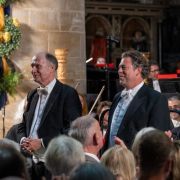
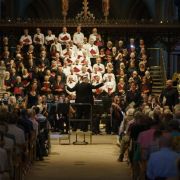
It’s a courageous move to take a great work from the Romantic canon, composed by a consummate master of orchestration, and shrink it down to chamber proportions while staying true to the original. As if to prove a point, the English Symphony Orchestra’s final concert of the year included two such acts of courage.

In the case of Strauss’ Four Last Songs, it was James Ledger who created the slimline version (in 2005). Immediately, Cheltenham’s Town Hall was transformed into something akin to a drawing room. Within it, salon music(!), displaying such clarity that all the inner details of Frühling were completely audible. Soprano April Fredrick didn’t seem to have got the memo about scale, her robust, full-throated delivery more suited to the full-size original, and in this context quickly sounding rather punishing.


The ESO were compelling, bringing lightness to September, with a playful flute and lyrical clarinet, and while Fredrick remained full force this was balanced somewhat by a sublime closing horn solo courtesy of James Topp. For Beim Schlafengehen, Kenneth Woods opted for a tender sound world, flowing carefully and affectingly. This was extended in Im Abendrot, though the orchestra’s restraint, now internalised, was again undermined by Fredrick’s over-enthusiasm.
Klaus Simon’s arrangement of Mahler’s Ninth Symphony is even more recent, premiered in 2012. It’s a formidable achievement, no doubt about it, though the reason it works so well is due to two key aspects of the work, both of which Woods and the ESO brought to the fore in their revelatory performance.
The first is its fragmentary nature; indeed, the symphony is practically fashioned out of bits and pieces of ideas that Mahler somehow, improbably, managed to weave together into the work’s complex fabric. The clarity heard in the Strauss here became total transparency. Hearing the fragments start to coalesce in the opening Andante comodo was very striking, all the more so as they bloomed, the ESO proving how much sound can come from just 19 players. This fragmentary quality became all the more telling as the music kept crashing back from attempted heights into abject uncertainty. Woods made every one of these moments more crushing than the last, turning nightmarish, threadbare, even skeletal, an effect greatly enhanced by the reduced forces.

The flipside was no less unnerving, the ESO sounding not merely frenetic but frenzied, desperation evidently fuelling the music’s efforts to rise out of darkness. They took this attitude further in the second movement, sounding a touch malevolent in its opening swagger, while the ensuing waltz seemed completely manic, Woods again handling the extreme gear changes of style and mood effortlessly.


The second aspect that made this performance so successful is the work’s preponderance of counterpoint. In Simon’s arrangement this becomes the intricate workings of an elaborate mechanism. Nowhere was this more vivid than in the Rondo-Burleske, which channels the fragmentation of ideas into a maelstrom of contrapuntal outpouring. In this version, the more exposed pantonal nature of Mahler’s harmonic language, replete with non-sequiturs and interruptions, unexpectedly brought to mind Darius Milhaud. Yet, again, the shift into lyricism was lovely and utterly convincing – grotesque briefly but genuinely forgotten – before lurching back into a full-throttle, carnivalesque ending.
Woods took the closing Adagio faster than usual which, with this reduced orchestra, worked perfectly. It became hyper-intense chamber music, picking up that short lyrical thread from the Rondo-Burleske and working it hard, never wallowing but, on the contrary, rendering it a proto-modernist peroration, laden with harmonic twists and crunches. It ended as it began, again in fragments, reduced now to an exquisite, excruciating string quartet.