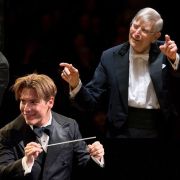
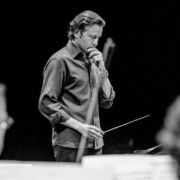
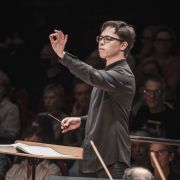
Ligeti’s Concert Românesc, written in 1951 and rooted in folk melodies from his childhood in Romania, opened guest conductor Gustavo Gimeno’s program with a reminder of a genre now rarely heard but always warmly welcomed. While its angular accents and catchy tunes may have recalled Bartók and Kodály, Ligeti’s score has its own unique rhythms and sound tapestries – clarinets doubling violas, pungent wind colors – and it brought forth the LA Phil's best playing of the evening, including confident warm solos from concertmaster Bing Wang.


The open-hearted tunes evoke wide Western plains – Copland by way of Transylvania – amid flashes of high Romanticism and the peculiar IMD (Inter Modulation Distortion) that Ligeti found so fascinating; demonstrated best by the pulses created by multiple Alpine horns playing intensely not well-tempered scales. The opening of the Adagio ma non troppo almost exactly matches the beginning of Bruckner's Seventh Symphony and the final movement, announced by trumpet and rustling strings, inevitably recalled the finale of Bartók’s Concerto for Orchestra. All these influences are so gracefully integrated into the music that they almost escape notice. Throughout the afternoon, Gimeno played down his own presence on the podium. It is nice when conductors do that; it allows attention to rest on the music, unless it is warning of a sudden fortissimo.
In Mozart’s Violin Concerto no. 3 in G major, K216, Renaud Capuçon was a smooth, engaging soloist; his habit of elegantly stomping around towards the ends of harmonic sequences added an entertaining degree of theatricality, and as the excitement mounted, so did the stomping. Balances were not always ideal and not enough space was given for the oboe to center its little tune, but there was a genuine sense of dialogue between the Frenchman and the orchestra which the Spanish conductor seamlessly facilitated.


The Adagio featured limpid violin playing, yet the tempo was glacial rather than the slow yet graceful that Mozart had in mind. The finale found a rakish Capuçon crossing swords with Mozart’s delicious sense of humor, and with a few bars of the fastest sixteenth-note passagework.
After intermission, it was good to bask in the vast Northern diorama that is Sibelius’ First Symphony, and Gimeno mostly let it go by itself. The opening clarinet solo lay suspended in space until the Allegro energico took off, the strings rustling than shining like an aurora borealis. In the second movement string-wind balances were problematic. The fugue in the Scherzo was initially untidy but eventually gathered momentum, and the little double bass solo was very cool. The orchestra let loose in the finale, and overall, the performance deserved the cheers of the audience.