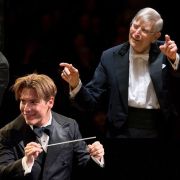
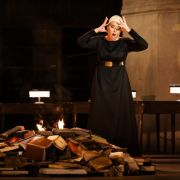
For an opera, reaching a 100th birthday is no big feat. However, the celebrations for the centennial of Alban Berg’s Wozzeck were rather noteworthy: a run of performances starting on the same day and in the very same theatre – the Staatsoper Berlin – of its premiere, under the conduction of Generalmusikdirektor Christian Thielemann. Other acquaintances old and new joined the soirée, in particular Sir Simon Keenlyside in the title role, Anja Kampe as Marie, and Andrea Breth’s production, which had its debut at the Staatsoper in 2011. And yet, the party wasn’t exactly jolly, since every Wozzeck birthday is also somehow a funeral.

This much seems to be clear to Breth, whose staging is as bleak as it can get. In order to get round the constant transitions between scenes, Breth maintains the same setting for all the three acts, widening it and shrinking it according to the narrative arc. The curtain opens on a low, greyscale wooden structure which reduces the stage to a fraction of its original size. Cold lighting and creeping shadows add to the oppressive, stifling quality of the production, and characters move like they are trapped in a cage. Interiors and exteriors are virtually indistinguishable, the only visible change being a gradual expansion of the set through the first and second acts. Even in the more animated tavern scene, where the stage is split into two levels to accommodate the band and the grotesque clientele, the space feels hostile and empty. In the last act the scenery starts contracting again, ending on a completely bare stage by the time Wozzeck kills Marie.


In terms of blocking, a few rough moments – Marie having sex with the Drum Major in front of her son, or the tavern patrons getting abjectly drunk – punctuated an uneventful performance, mostly reliant on the singers’ skills. Overall, giving soloists and audience alike so little to work with did not benefit the production, which seemed scant, rather than minimalist. Wozzeck’s parable is tragic and caustic for sure, but Berg’s commentary is not sadistic. There’s much animation in the apparent stagnation of Wozzeck and Marie’s misery, especially in their relationship towards their own bodies and respective places in society. Unfortunately, none of the traits that make these character complex were translated scenically.

The hollowness of the stage did not transmit to the pit. From the podium, Thielemann adopted an antithetical approach where the low winds provided almost constant volume, busying themselves with the perpetual churning of Berg’s music. It was striking how the score folds on and absorbs itself while also being so in touch with the events on stage. In Wozzeck, music is at once an emanation of the characters and in dialogue with them. Thielemann’s interpretation reproduced this density through a murky timbral foundation where crystalline instruments like the solo violin, celesta and harp sounded especially hallucinatory. Good control over dynamics and harmonic movements helped the audience through the rich polyphonic weave. When Thielemann did push towards a fortissimo and beyond, the effect was overwhelming, the distortion almost frightening. Granted, I still have reservations about such a ripe, hefty rendition of Wozzeck but if it must be so, let it at least be in the capable hands of an ensemble like the Staatskapelle Berlin.

Jagged vocal lines and an often abstract libretto make Berg’s opera thorny for singers. As Wozzeck, Keenlyside made his character into a bundle of nerves, both musically and physically. His agitated, mobile phrasing was matched with nervous gestures and movements on stage, giving the impression of a hunted animal. Under this disguise, however, his baritone was still as compact and precise as the score requires it to be.


Marie’s motivations are ultimately manifold and ambiguous, which leaves much room for interpretation. Kampe decided to tone down the most risqué traits to focus on Marie’s inertia and surrender before a system that crushes her even more than it does Wozzeck. Underscoring the tragic nature of the role, the singer comfortably plunged into the lower notes and added depth with a naturally dark soprano. The frequent jumps across registers also constituted no issue for Kampe, the only one among the cast whose character allowed for some trickles of lyricism.

With his deep, solid bass, Stephen Milling’s Doctor embodied the absurdly cruel fate that torments Wozzeck, while the rest of the cast – Andreas Schager as the Drum Major, Anna Kissjudit as Margret – contributed to the ensemble with convincing performances.