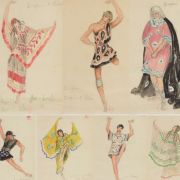
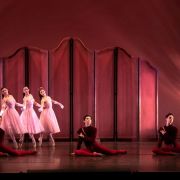
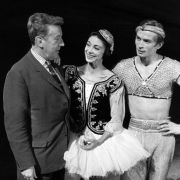
Having worked with the Ballets Russes, most notably with Vaslav Nijinsky on his 1913 creation, Le Sacre du Printemps, Marie Rambert became a pioneer in British ballet: setting up a ballet school, and then establishing her own company, the first in the UK, Ballet Rambert, which she led for 40 years after its founding in 1926.

Rambert’s life is best learnt about in her extraordinary autobiography, Quicksilver. Her irrepressible energy flies from the pages with a dazzling brightness, as you laugh uncontrollably or sit stunned in opened-mouthed amazement. Celebrating the centenary of her company in 2026, there is no better place to begin.
The group which Marie Rambert founded is now known simply as Rambert, Britain’s foremost contemporary dance ensemble. During 2025 it toured internationally with its hugely successful hit, Peaky Blinders. One of the most popular dance companies in the world, Rambert has a reputation for attracting first rate dancers and choreographers. However, today’s troupe bears little relation to the vision of its founder.
What Rambert achieved in 40 years was remarkable. Working with meagre resources, whether in cold rented studios or the tiny Mercury Theatre, a converted church in Notting Hill Gate, her company managed to produce an enviable body of new work.
Rambert also spotted and developed the choreographic potential of Frederick Ashton – he made his first ever work A Tragedy of Fashion for her and her dancers in 1926. With Rambert’s support, Antony Tudor created notable masterpieces, some of which are still performed today, though sadly they no longer have a natural home in Britain.

She encouraged many choreographers including Frank Staff, Walter Gore and Andrée Howard, all of whom created successful original ballets, and she gave infinite opportunities to dancers, musicians, and designers. Her classical company, Ballet Rambert, performed in London and on extensive regional tours, cultivating audiences across the UK. They performed internationally too, making notable appearances in Australia, China, the USA at Jacob’s Pillow, Italy, France, Malta and the Middle East, many of which were firsts for a British arts organisation.


Full-length ballets also constituted part of the repertoire: Dame Marie was particularly proud of the company’s production of Giselle and in the early 1960s Ballet Rambert gave the British premieres of La Sylphide and Don Quixote.

Put simply, British Ballet would not exist as we know it without Marie Rambert’s pioneering zeal – yet despite her greatest efforts, money was always scarce. On numerous occasions Rambert lost artists to her close rival, Dame Ninette de Valois, who offered greater stability and better conditions.
Undeterred, Rambert found and fostered new talent, but by the 1960s her company desperately needed more funding and new premises. Plans for a purpose-built venue with the Royal Shakespeare Company fell through as did a merger with London Festival Ballet.

Unbeknownst to Rambert, three of her own dancers, Norman Morrice, John Chesworth and Jonathan Taylor were involved in secret discussions. Headed by Morrice, they suggested turning Ballet Rambert into a scaled-down contemporary dance company. In a move aligned with their own choreographic ambitions, they could dismiss the large ensemble and full orchestra – a cost reducing proposal readily embraced by the Arts Council.
This fait accompli was presented as a temporary solution: facing a dire financial situation Marie Rambert had no choice but to accept. Before assuming directorship of Ballet Rambert, Morrice had arrogantly declared to a colleague, “Classical ballet is dead”. He would later become director of Britain’s Royal Ballet.
I have had the pleasure of knowing several dancers who worked under the leadership of Rambert, or ‘Mim’ as they affectionately called her. Each speak of her with great fondness as they recount colourful stories from their Rambert days. On stage, John O’Brien remembered Rambert out front watching the performance. “If you heard the bang of the auditorium door, you knew Mim was coming: the next moment she’d be issuing commands from the wings. ‘Streeetch that foot! Oh, hideous!’’’
Joanna Banks takes up the story: “She’d seen Giselle many times and took to walking up and down the wings shouting, ‘Oh, pull your shoulders down Rachel. Joanna – do make your neck longer!’. The entire line of Wilis twitched with her corrections.” Maggie Lorraine, Rambert’s last protégé, tells of Rambert audibly instructing her from the bottom wing during Coppélia.
Each time Rambert is quoted, the dancers imitate her voice identically: thickly accented; a dose of mock displeasure; pauses for dramatic effect. I ask if the public was aware of the source of commotion. “I’m not sure,” Lorraine replies, “but the stage manager wasn’t very happy. He eventually barred her.”
Rambert’s larger-than-life personality brought out the best, and occasionally the worst in people: she sought to provoke. Banks recalls Rambert deliberately agitating cast members just before performances of Tudor’s Dark Elegies, the ballet concerning a grief-stricken community, set to Gustav Mahler’s Kindertotenlieder. Banks explains, “Rambert was difficult, she could be cruel, but the company was like a glorious, integrated family. Whenever she upset anyone, everyone else would rally around.”
Both Banks and Lorraine remember seeking consolation and advice from fellow dancers, O’Brien and Kenneth Bannerman who acted as company counsellors before such positions existed.

Lorraine confirms with laughter, “Rambert used to pull me to pieces, even while I was trying to get ready for the next act, saying ‘Oh, I could hardly look at you’. No sense of the appropriate time to criticise! But,” she continues, “for all her exasperating ways, there was something wonderfully endearing about the sheer force of her passion. Everything Rambert did sprang from her love of the art and her perfectionism.” And Banks muses, “Mim was often just making observations, without malice.”


Banks and Lorraine speak with great admiration of former colleagues: the artistry of Gillian Martlew and June Sandbrook; Lucette Aldous’ sublime technique. Banks remembers the “pleasure of watching Lucette dance the most impeccable Don Quixote pas de deux every night. And Ken (Bannerman), the most amazing partner. Magical.” Both mention the hours of extra coaching that Aldous received for Kitri from O’Brien: Banks says, “He made her in that role. He really did.” O’Brien remembered what a brilliant coach Rambert was, noting, “She could transform a dancer in any role.”
Rambert, who cartwheeled well into her 80s, evidently inspired energy in those around her. Did she plan for a successor, I wonder? “Rambert could have continued,” Lorraine opines. “She was bright as a button and never hogged centre stage.” And David Ellis? “He was a great support to her.”

Ellis was Rambert’s son-in-law and associate director. Banks describes how the two alternated ballet master duties on long regional tours: “Rambert would arrive with so much energy, give a demanding class and might recast everything just to spice things up. By Friday we were exhausted and I admit, we often heaved a sigh of relief as we saw her taxi disappearing. Then David would come. He was lovely and kind and gave a good class, but by the end of the week one craved a bit of madness, a bit of excitement. Come back, Mim!’’
I wonder how the company learnt about the drastic restructuring. “We were on tour” Banks explains, “Liverpool, a Spring night on a Monday. The company manager, Fred Bromwich, was there, strange because usually he only appeared on Fridays. Suddenly, the stage manager, Bill Ferguson, posted a company meeting at the half. In a couple of sentences Bromwich told us that the classical company was no longer viable – our contracts would be honoured until June. It was awkward for him. And for us.
“It split the company. Some company members already knew. I remember we were dancing Giselle and I thought, it doesn’t matter too much that we’re crying, it’s only a bit too early in the first act. The tour finished in Golders Green. Over half the company went their separate ways.”

Morrice, assuming the reins, communicated with several dancers to discuss their futures. He offered Lorraine a contract, but she had no desire to dance only contemporary work. Lorraine says, “He responded that he thought it good for me to be released from her. I think he was happy to loosen Rambert’s hold.” To Bannerman and O’Brien, he said, “I can only take one of you.” Both chose to leave.
In June, the company gave a final one-off showing of Tudor’s miniature comic ballet Gala Performance at the Theatre Royal, Drury Lane. Banks describes the scene: “I have never forgotten as we left the stage door, Rambert – just standing there, so vulnerable. She was tiny anyway, but she seemed to have shrunk. She was heartbroken. We were heartbroken. I had taken the slings and the arrows, but she fervently hugged each one of us goodbye and told me, ‘Joanna. You’re a beautiful dancer. You’ll find a way.’ It was so incredibly sad.”
Rambert’s company, a lifetime’s work – snatched away from her. Naturally, some people’s loss was others’ gain. In public, she gave the new venture her full blessing: survival instinct? Quicksilver is devoid of any criticism regarding the machinations of 1966. Privately she later lamented, “What have they done to my company. What have they done?”
Joanna Banks continues her performing career with Company Philip Connaughton and will be performing internationally during 2026.
Maggie Lorraine recently designed the pointe-work syllabus for Cecchetti Ballet Australia and is currently writing a book about her life.
See reviews and upcoming performances from Rambert.