Thomas Adès has described composing as “organizing chaos”. If his recent appearance with the Czech Philharmonic is any indication, the same might be said of his conducting. Adès strode onstage like a man on a mission, took a gracious moment to connect with the audience, raised his arms and unleashed an evening of controlled bedlam. The only thing missing was the flash and crackle of actual fireworks bursting in the background.

His style fit the occasion: the 100th anniversary of Pierre Boulez’s birth, which Adès celebrated with a resonant program featuring two of his own works, small gems by Boulez and his admirer György Kurtág, and pieces by Busoni and Ravel connected by, of all things, a common thread of waltzes. Riveting performances were aided in no small part by two of Czechia’s finest young soloists, cellist Václav Petr and violinist Josef Špaček.


The waltz strains framed the program, which opened with Busoni’s Tanzwalzer, a modernist tribute to Johann Strauss. Adès spun out the waltz melodies with lyricism and grace, though his emphasis was on the tension and excitement in the piece. The sound was bold and exuberant, the highlights sweeping and impactful. His approach was much the same in the finale, Ravel’s La Valse. Elegant waltz melodies were buttressed by propulsive rhythms and dark undercurrents, which concluded in a fiery frenzy. Both pieces were originally conceived as ballet music, but in Adès’ hands they offered an insightful look at the tipping point between 19th- and 20th-century music.
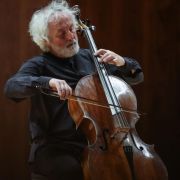
Pairing Boulez’s Messagesquisse with Kurtág’s Petite musique solennelle, written as an homage to Boulez, gave Adès an opportunity to show fine skills with minimalist fare. The Kurtág offers unusual, often ethereal sonics that Adès invoked and expanded expertly, punctuated by sharp sounds from the chimes. Messagesquisse is a piece for seven cellists that starts softly and builds to a frantic hum, showcasing demanding solo work by the lead cello player. Petr was outstanding in that role, turning in a notably precise, commanding performance.

The Adès pieces were the heart of the program, and watching him conduct his own work was a rare treat. His Air – Homage to Sibelius concluded the first half in mesmerizing fashion, with fingertip control of the orchestra giving body and warmth to lines that seemed to float off the stage. Quite literally, he fluttered his fingers at times to craft delicately calibrated sounds. Matching his finesse, Špaček offered virtuoso solo work, playing with soulful tenderness. And his 1732 Guarneri gave the sound a golden glow.


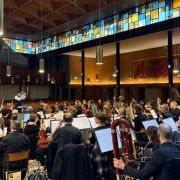
After intermission, The Exterminating Angel Symphony roared through the Rudolfinum like a runaway train, with stormy strings, stentorian brass, dramatic percussion and abrupt turns of phrase and mood crashing in high-volume cacophony. The second movement sounded like the orchestra was tearing itself apart. But the music was compelling, and the kaleidoscopic variety gave it a thrilling edge of unpredictability. Adès worked up a sweat conducting, and his efforts were reflected in an enthusiastic response from a full house.

Along with an electrifying performance, the evening offered a reminder that there is no reason to be locked into the standard concert format of short piece–concerto–symphony. A lot of very good music falls outside those parameters and when it is presented in a thoughtful, thematic manner, it can be both enlightening and entertaining. Having someone of Adès’ expertise and accomplishments on the podium doesn’t hurt, either. Put him in front of a world class orchestra, and you’re in for a rip-roaring ride.