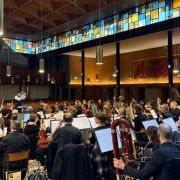
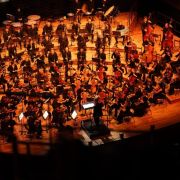
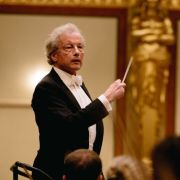
“Never look encouragingly at the brass,” is the most famous of Richard Strauss’ Ten Golden Rules that he penned for young conductors in 1922. Karina Canellakis happily ignored that advice in her performance of his tone poem Tod und Verklärung (Death and Transfiguration) with the Vienna Symphony at the Musikverein. She beamed at the horns and egged on the trombones in a ripely dramatic reading that was the best Strauss I’ve heard in concert for years.

The first of Strauss’ maxims, less widely reported, is: “Remember that you are making music not to amuse yourself but to please your audience.” Canellakis eschews any grandstanding on the podium. Her conducting is wristy, her beat economical, large enough for the orchestra to follow, but not so large that it becomes audience semaphore.


Tod und Verklärung traces the final moments of our protagonist, an artist; a deathbed scene where, during his struggles with death, he relives a flood of youthful memories. After death, his soul is transfigured in a glorious, transcendent close. The young Strauss was concerned his audience wouldn’t understand the work without knowing this synopsis and included his friend Alexander Ritter’s verse treatment in the published score.
No such synopsis was required here, the music telling the story with clarity. What most impressed about Canellakis’ conducting were the narrative arcs and the lucid transitions between sections, shaping the score in long paragraphs rather than lumpy episodes. From the irregular pulse of the dying man, through the agonised death throes to the heavenly close, this was a reading of the utmost coherency, the Vienna Symphony responding with teasing woodwinds – a seraphic flute solo – and thrusting brass, all beautifully balanced. Even during the ecstatic climax, the pealing of both harps could clearly be heard, such is the fabled acoustic of the Musikverein’s Golden Hall.

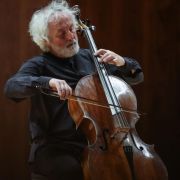
That golden glow echoed the gilded horn that opened Brahms’ Second Piano Concerto which featured Leif Ove Andsnes as soloist. The Norwegian powered through the peaks of the Allegro non troppo first movement with leonine strength and Brahms’ “little wisp of a Scherzo” with plenty of muscle, but this was largely an expansive, poetic reading. Principal Cello Michael Vogt provided a supple, flowing solo in the Andante, eloquently answered by the bassoon, Andsnes and the orchestra soon engaged in the most collegiate dialogue. He set the finale off in an amiable mood, Canellakis weaving together the several themes before the gleaming close.


In between came a rarity, Dvořák’s symphonic poem, The Noon Witch, narrating a tragic tale where a mother warns her son that, if he doesn’t behave, she will summon the Noon Witch to take him away. Needless to say, said boy does not behave and, believing the witch has appeared, the terrified mother accidentally smothers her son. Not exactly child-friendly material, and the curious piece has its longueurs, but Canellakis never let the tension sag. She drew out the malevolence in the dissonant woodwind writing and, finally allowing herself the luxury of a few dramatic gestures, fired up the orchestra for a crackling coda. Dr Strauss may have disapproved, but rules are there to be broken, right?