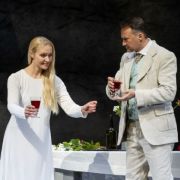
In the dance between specificity and universality, it is difficult to create a meaningful character who feels familiar and real. Christof Loy’s production of Tosca at Finnish National Opera centers psychology with such clarity that language, culture, costume and era seem inconsequential in and of themselves, rather than for how characters use them to share their story.

The impression of Tosca is of a woman keenly aware of the tools within her grasp; the jealousy that fuels the story comes across not as weakness, but as awareness of the boundaries of her power. She is not conniving, per se, but rather a psychologically complex woman trapped in a story that wants her to be far more simple.
Elisabet Strid was well suited for the role, projecting throughout the hall with no loss of clarity, impeccable execution of messa di voce and the ability to shift the weight and balance of her voice within a line so confidently and cleanly that it felt as if the audience were in Tosca’s head, privy to the strategy that turned a commanding, brackish tone into something loose and sweet.


Having been well set up by a brilliantly choreographed tête-à-tête with her Scarpia, Strid executed her “Vissi d’arte” as if a prayer before an imminent assault. She skillfully turned her voice from pure plea into crumpled cry, beautifully hinging her arc on the aria. It was a performance that earned more than a few tears.

The Tosca of the third act is a different woman than the one we knew before. Strid handled the change convincingly, replacing the legato and emotional control of the first two acts with a trembling, ethereal voice befitting the unhinged, deeply traumatized murderess.
Cavaradossi is not an obvious heartthrob, but plainly recognizable as a very normal sort of boyfriend: utterly confused about, even dismissive of, Tosca’s suspicions as he proceeds to do very suspicious things. Milen Bozhkov had a rough start in the first act, failing to project substantially for a handful of phrases, and for one clearly unable to make the jump over the pit. When pushing to his upper extremes, his voice was noticeably pressed. In the final act, when the physical acting demands were all but eliminated, an undeniably beautiful timbre was revealed, coupled with sustained emotional depth.
It’s difficult to see this Scarpia as anything other than incel incarnate – but certainly a brilliant one. Perhaps not naturally villainous, we are made to believe that his reason and self-respect simply cannot withstand the force of the fantasies that possess him. Sung powerfully and eerily by Tuomas Pursio, we were given the picture of a man driven mad with desire. In spite of the near-constant writhing and gyrating, Pursio produced a baritone that was deep, dark and dynamic enough to feel as threatening for its force as for its unpredictable little jumps between timbres. Well-acted and solid in his vocal delivery, one of the most striking moments of his performance was when, in a spark of lucidity that punctuated his verbal duel with Tosca, his voice slipped into such a soft, human warmth that he became, inarguably, another victim in the story, tortured by his own inescapable mind.


Other characters of note include Scarpia’s terrifyingly creepy marble-faced goons, and the adorable gaggle of swooning altar boys. But the Jailer, played by Henri Uusitalo, provided an uncanny amount of ambiance to the final act. While his few lines were delivered admirably, the emotion in his face, his posture, his gait, were some of the most articulate gestures of the evening. The moral voice lacking in the silent depictions of religious figures and institutions throughout is perfectly, terrifyingly present in his silence.
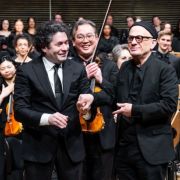
The orchestra played with joyful fidelity, creating compelling internal and external worlds to support the singers. Guest Conductor Xian Zhang, quite a distance from her long-term gig leading the New Jersey Symphony throughout the Garden State or her new podium in Seattle, supplied plenty of energy and enthusiasm, alongside some pointed and thoughtful direction, leaving the theatrics to those on stage. If there was one moment the balance seemed off, it came across as being on Bozhkov for his reluctance to project during the first act.

With a little more concern for the staging of the final few scenes, this production would easily fill out the full five stars. As it stands, with the superbly gifted and committed cast the show is an exemplar of how orchestra and singers are meant to share the story they inhabit, good acting that mostly doesn’t interfere with excellent singing, and solid testimony to Tosca’s timelessness even well into its 125th year.