As Birmingham plunged into sub-zero temperatures on Wednesday evening, the two composers heard inside Symphony Hall seemed to be leaning either towards or away from the cold and darkness. Recoiling from it in relatively milder climes was Sibelius. That certainly seemed to be the intention of soprano Helena Juntunen, who threw herself into the songs’ respective dramas far more than the City of Birmingham Symphony Orchestra and Osmo Vänskä. As such, she felt extremely separate from the orchestra, which was seemingly reluctant to do anything more than offer mere support in Autumn Evening, sounding matter-of-fact in Baron Magnus and Spring is Flying.

For her part, Juntunen was fully immersed in their narrative worlds (and attired, complete with a costume change), never more so than in Luonnotar. She was by turns anxious, desperate, imploring and prophetic, yet the CBSO seemed content simply to provide suggestions of atmosphere. This made the work’s curious conclusion, where the sky is formed from eggshells, seem downright strange, incongruously laden with mysterious portent. Juntunen deserves an award for staying so completely focused alongside such indifferent accompaniment, a trait no less evident when the CBSO were left to their own devices, through a stodgy Karelia Suite (with very poor balance in the opening Intermezzo) and an account of The Bard that consisted of little more than shapes and gestures.


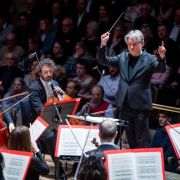
One couldn’t help feeling that the responsibility for this lay squarely on Vänskä’s shoulders. While he went through the motions, there was little sense that the music mattered, its power and potential thus remaining locked inside, unable to be released. This was emphatically confirmed in the second half, in a dismal rendition of Shostakovich’s Symphony no. 15. It’s a weird piece, sure, but it’s not just a chop-and-change, cut-and-paste farrago. Yet this is precisely what we were given, Vänskä treating each new idea like a spontaneous thought that had occurred to Shostakovich without reason or context. On top of that, the first movement was a mess, strong ideas muffled while secondary ideas protruded crazily. Coordination was ragged and unkempt, the prominent violin solos botched. The orchestra managed to redeem itself in the second half, but this was a startlingly inept way to begin, one not remotely in keeping with the way the CBSO has played in recent times.

They were best in the second movement, the first of the black Adagios, with the brass creating velvet solemnity, while the music felt ever more disquieting as it became increasingly pared back. It was not merely enervated but drained, as if by a vampire, making the prominent trombone solo akin to a Mahlerian call either to, or from, the grave. Yet here and elsewhere, Vänskä seemed impatient, rushing through the climactic tutti as if keen to return to the cold, barren landscape. The Allegretto had strong continuity, seemingly bleached by the Adagio and as a consequence threadbare, shrill and rattled, a true danse macabre. Unfortunately, the soloistic issues persisted, and as ideas were briskly passed around the orchestra, the players’ confidence and surety seemed to ebb away rapidly.


Maybe Vänskä was just irritated by what he could tell was a poor performance, but that doesn’t excuse turning the final movement, Shostakovich’s symphonic valediction, into something so rushed and incoherent. The woodwinds were touchingly forlorn, the strings managed to evoke a kind of ‘afterlife music’, but these moments were ruined by a conductor seemingly concerned with getting it all over and done with as quickly as possible.