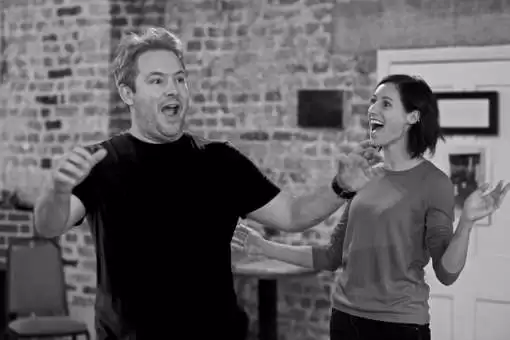
“I do see a major problem with operatic acting. I still have to deal with singers pointing at everything all the time.” Selina Cadell, actress, director and Head of Drama at the National Opera Studio for 20 years, flings her arms dramatically. “You can get away with grand operatic gestures anywhere if they’re truthful, but most of the operatic gestures that happen aren’t truthful.”

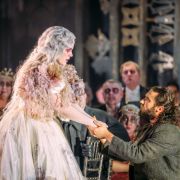
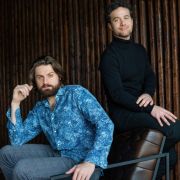
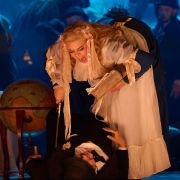
I’m in a studio at Wilton’s Music Hall, having watched Cadell rehearse Rob Murray and Jonathan Lemalu in a scene from Stravinsky’s The Rake’s Progress, the first production staged by the new company she’s set up with dramaturg and fellow producer Eliza Thompson, OperaGlass Works. Formed as a way to respond to how the opera world has changed in recent decades, the seeds of the company were sown when Cadell was invited by Nicholas Hytner to lead a National Theatre workshop exploring the relationship between Auden’s libretto and Stravinsky’s music. Tenor Rob Murray took part and, as Cadell explains, “we’ve been trying to get a production together ever since. We said for years we’d do it but, in reality, who’s going to ask us to do The Rake’s Progress with Rob and other people that I know? It was never going to happen. It was Laurence Cummings (with whom Cadell had worked on Arianna in Creta at the Royal College of Music) who pushed us into it.”


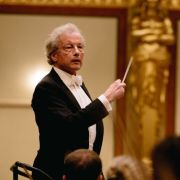
“The Rake’s Progress has this fantastic harpsichord part,” interjects Thompson, “so for Laurence – a Baroque performer – there was something thrilling for him about this neoclassical world.” In their production, Cummings will direct the Southbank Sinfonia, the musicians sharing the stage with a cast including Murray, Lemalu and Susanna Hurrell.

OperaGlass Works represents a desire to shift the operatic goalposts in terms of acting. “There’s a lot of fantastic opera in this country,” Cadell says, “but there is also a tradition of opera being (a) seen as elitist and (b) you fly in from Paris or Berlin, stand where you’re told to stand and pick up the handkerchief on the same note as when the production was new 40 years ago. I understand why that happens but are we paying too much for productions? Are we charging too much for tickets? It’s a catch-22 situation but there must be another way, so we thought if we try and launch this company with this project it might make people realise that you can fund opera differently.”
Thompson joins in. “Is it possible to create an excellent new production with a really good cast of internationally renowned singers and excellent musicians and designers… but cheaper? And with a five week rehearsal period as you would in the theatre?”
“We had to set about finding money. I don’t think either of us knew how hard that would be,” confesses Cadell. “We found it through many different sources… we’ve even robbed a couple of banks!” she laughs raucously. Thompson explains that most of the funding has come from trusts and foundations and through opera-loving philanthropists who believed in their concept.
Text is paramount to Cadell. “Fundamentally, I don’t like separating the world of acting from the world of singing. Music and acting are congruent. The presence of the audience is the sole purpose of opera – it’s why you are here. The Rake’s Progress is set in a classic 18th-century form. My feeling is that opera is an artform that is very heightened and people have got very muddled recently pretending it isn’t a heightened artform, that it is a naturalistic thing and no one’s singing and that’s very hard to understand.”
“I think that’s why Selina is so good at this,” enthuses Thompson, “because a lot of what she’s done is 18th-century theatre which has the same heightened reality – everyone’s called Trulove and Rakewell – and you sort of know where you are and you accept this convention in which the actors talk to the audience and actually engage with them. It’s not about audience participation, it’s about engagement.”


“It’s about embracing the fact that we wouldn’t be there if it wasn’t for the audience!” states Cadell emphatically, expressing her desire to tear down the fourth wall. “If you decide to sing to people, you actually commit to the truth of the moment in that moment. When you’re pretending the audience isn’t there, you do this thing where your eyes go into the middle distance and your shoulders go up and there’s no connection anywhere and your voice suffers because of that. We’re both big believers in that famous Maria Callas quotation: ‘If the thought is right, the notes will follow.’ The fact is they do, but you can’t do it without a lot of work first.”

Thompson is billed as dramaturg, a title not often used in UK opera companies. What does the role entail, I wondered. “The great thing about the word ‘dramaturg’,” she admits “is that it can mean all sorts of different things and I think that’s why it was such an appealing title.”
“We work in a very creative way,” Cadell explains, “and Eliza’s eye for text and on unpicking the structure is excellent. The narrative of an opera is fully and exquisitely formed… and yet often it’s completely ignored or reinterpreted. You need to know what you are saying and why you’re saying it. You also need to know that you’re in an opera. You’re allowed to be a singer! Lots of singers pretend not to breathe!”
I muse that so often people in opera make excuses for opera to try and make it appealing to new audiences. Thompson takes up the theme, “And that’s not what making opera accessible is about – what makes opera accessible is actually telling the story to the people. Just putting on modern dress doesn’t do it.”
“It’s so liberating,” Cadell responds, “just telling the story. People say to me, ‘this is so new, so radical’. It’s not. It’s how they were written. People have asked me ‘How are you doing The Rake’s Progress?’ and I always feel a bit empty when they ask that. I’m not doing the ‘how’ at all… I’m doing The Rake’s Progress. I’ve done too much theatre where I’ve had a marvellous part in a marvellous play and then you arrive for rehearsals and find it’s going to be set in Hitler’s Germany. What we’ve forgotten is that just because we know the story, that doesn’t mean we have to do something new with it. What we should be doing is making our stories so extraordinary that we think that this time the ending will be different.”
Will Tom Rakewell resist the temptation Nick Shadow throws his way? The Rake’s Progress opens at Wilton’s Music Hall on 17th November.