The opening of the Teatro dell’Opera di Roma’s 2025-26 season was an event in more than one respect. Wagner’s Lohengrin hadn’t been staged in Rome for 50 years, although being very popular here (as in the rest of Italy) until the first half of the 20th century. This was also the first time it was sung here in the original German, instead of the Italian translation the opera was performed in since its 1871 Italian premiere.

Lohengrin, which is said to be the most “Italian” of Wagner’s operas for its more marked melodic character, is an unusual mix of fairytale, history and drama. It tells the story of Elsa, heir to the Brabant duchy, who is unjustly accused of fratricide by Telramund and his wife Ortrud. While she is about to be judged by the King, a mysterious knight (Lohengrin) appears on the river, in a little boat pulled by a swan. He duels and defies Telramund, saving Elsa and winning her hand. But he imposes a condition on her: she should never ask his name and where he comes from.


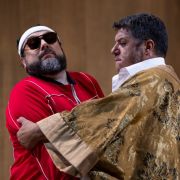
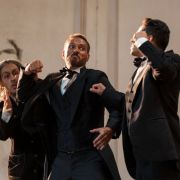
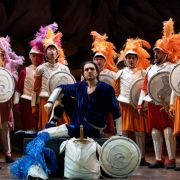
This new staging (a co-production with Palau De Les Arts Reina Sofía and Teatro La Fenice) was entrusted to Damiano Michieletto, whose very name raises eyebrows among the more traditionally minded. Their worst fears must have materialised pretty soon when, as the curtain rose, over the graceful strings of the sublime prelude meant to convey the transcendence of the story, there was a brightly lit bathtub in the middle of a bare stage. This initial oxymoron gives the key to the whole production. The direction plays freely with the libretto in a sort of intellectual game where the dramaturgic sources are quoted in a parodic way (the bathtub for the river, Lohengrin pulling a little white coffin with a swan symbol on it, Elsa half buried on the floor as the mother in the swan-children fairytale) and metaphors are visually represented on stage (the eggs as the real “origin” of Lohengrin and the secret around it).

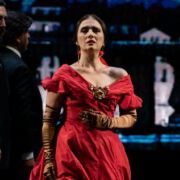
We are not in the Middle Ages but an abstract time and place. Carla Teti’s costumes are modern, common in opera today, but in a way that is unsuitable to the story at hand. Lohengrin, all in white, seems to be dressed for a summer barbecue, while Elsa takes the prize for the most unflattering outfit in the production: a nurse-like dress and long, dirty hair. The stunts by set designer Paolo Fantin, like the metal eggs slowly falling from the ceiling, may look visually enticing (even more so in Alessandro Carletti’s beautiful lighting), but they remain distractions from the story.

The result of this direction is unfortunately a pastiche, which doesn’t add to the work, but detracts from it. There are operas that lend themselves relatively well to a modern reimagining, but Lohengrin isn’t one of them. The grandeur of the music and the spiritual themes of the opera require a grand, mythological setting; exactly as Wagner depicted it. Metaphorically speaking, there is no substitute for the swan!


Thankfully, the musical side of things redeemed the whole evening. A very good cast was assembled for the occasion. Dmitry Korchak, with his lyrical and warm tenor, highlighted the romantic side of the hero, Lohengrin. Soprano Jennifer Holloway sustained the part of Elsa very well, even while half buried on the floor for no reason. Tómas Tómasson (Telramund) and Ekaterina Gubanova (Ortrud) were the perfect evil couple, the first distinguishing himself for his acting and the second for her strong, high reaching mezzo-soprano. Clive Bayley was impressive as King Heinrich, as was Andrei Bondarenko’s Herald, even if in a relatively minor role.

But the real stars of the show were the Orchestra and Chorus of the Teatro dell’Opera di Roma, conducted by Michele Mariotti, brilliantly managing an exceptional number of elements in such a long performance. The company certainly rose well to the challenge of staging Lohengrin again after five decades, marking it a high point in its repertoire.