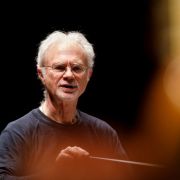
Introducing this Scottish Chamber Orchestra programme dedicated to John Adams works spanning almost 20 years, conductor Andrew Manze encouraged us to look beyond the composer’s famed minimalism, like taking a tiny grain of sand and putting it under the microscope. Three very contrasting pieces showcased different sides of Adams who was influenced by folk, church and big band music, intrigued by rhythm and musical sequences, but a man who always thought of himself as a “provincial composer”.

“Gnarly” is a strange word, its contrasting meanings entirely depending on context: a dangerous wave in surfing, having a cantankerous attitude or the worn gnarls on the handle of a village elder’s walking stick. For the work at the heart of this programme, Gnarly Buttons, one might choose: challenging, like a tricky task and most appropriately and simply, awesome. Adams was also a clarinetist, taught by his father, playing with him in local marching bands, Benny Goodman a huge influence. Written in 1998, ten years after Nixon in China, the three-movement work is scored for strings with a trombone, bassoon, cor anglais, banjo and guitar, two synthesisers and piano.


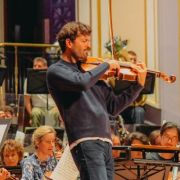
SCO Principal Clarinet Maximiliano Martín stepped into the solo spotlight, a player intrigued by this odd, difficult work which features a central Rodeo complete with a mooing cow and banjo, and a surprisingly emotional finale.
In an almost continuous stretch for the soloist, Martín’s clarinet took on long solo passages, more sprightly as the players developed a jazzy walking beat, the two synthesisers adding a blurry fairground organ edge to a single melodic line. The lively rodeo was a tremendous stampede, syncopated accents and cross rhythms challenging the listener to pin down a beat, the emerging banjo and propulsion from the synthesisers outshone by Martín’s liquid expressive clarinet, the blues never far away. The finale, Put Your Loving Arms Around Me, was quieter, more nuanced with some expressive interplay between soloist and bassoon, the guitar and trombone adding unsettling colours. Adams wrote the piece as his father was living with Alzheimer’s disease, Martín completely inhabiting the melancholy in a moving performance.
Adams’ 1978 work Shaker Loops was written for string septet, but played here for an expanded string orchestra, the musical loops of different sizes, like wayward planets in a solar system drifting in and out of alignment. From barely audible beginnings, the shaking and trembling grew, Manze calm and precise, directing every accent in a crescendo as the grumbling basses arrived. In a continuous work, the central two sections were quieter and hypnotic, high-pitched harmonics sounding like a squeaky wheelbarrow wheel, long mesmerising notes interrupted by the soft chatter of the second violins. A cello flourish signalled a build to the Final Shaking, the music gaining momentum like a runaway train, the rhythmic unison passages breathtaking.


Written soon after Nixon in China, Fearful Symmetries was a splendid workout for full orchestra, two synthesisers driving a relentless chugging beat, a saxophone quartet adding urban grit in the signature Adams sound world of the opera. A work suggesting travelling through a busy cityscape, I loved the baritone saxophone and bass trombone blasts, the clarinets blowing phrases across their music stands, the flute loops, the complex rhythms and sweeping and sudden chord changes. Manze was on top of it completely, giving clear direction in a piece which was packed with joyous exuberance, continuing the orchestra’s excellent New Dimensions programming.