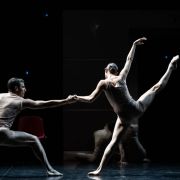
The thing that makes NDT 1 particularly challenging to review from a dancing standpoint is that the dancers are just simply that good. The world-renowned company is an amalgamation of some of the most talented dance artists from across the globe; each one a polyglot of contemporary dance lexicons who as unit, deftly move through space with precise and fierce intentionality. It’s no wonder that choreographers set their sights on producing original pieces with this dance institution.

Their work is often enriched by the intimate connections undoubtedly forged in the studio. The resulting brilliance between choreographer and dance artist was certainly on display Wednesday night with NDT 1 showcasing three distinct original works from their repertoire.
Mémoires D’Oubliettes, is Jiří Kylián’s final work for NDT 1 which premiered in 2009. Emerging slowly through a backdrop designed of numerous black filaments tautly extended from the ceiling, the dancers entered the liminal space bearing maniacal grins, bowing luxuriously to the audience with overblown bravado. The piece moves like a fever dream of fragmented moments and memories, each solo and pas de deux suspended in time, evoking feelings of poetic dissonance.


The dancers on Wednesday performed confidently with an expert knowing of weight distribution and intimate connection that gives Kylián’s complex physical configurations its signature sensuality. The whimsical use of silver cans that were swept along the stage by a push broom bordered on gimmicky but became a profound counterpoint, adding a gritty textural element that, in the end, grounded the work.
As Artistic Director of NDT for nearly 25 years before stepping down in 1999 (and acquiring the title of resident choreographer for a decade more) it suffices to say that NDT is indebted to Kylián and his work. I, for one, am grateful to see NDT continuing to honour this legacy.

Final kudos to the dancers on Wednesday whose performance, if the liner notes about the casting are indeed accurate, was accomplished by utilising artists from both casts. Perhaps not so astounding to the dancers themselves but still a testament to the professionalism and work ethic of NDT that facilitates potential last-minute switch ups for various reasons.
Having seen Crystal Pite’s seminal work The Statement, before, I hadn’t anticipated the ripple of laughter from the audience at the start. Almost ten years since its premiere in 2016, it goes to show how the piece continues to resonate in startling ways amid late-stage capitalism.
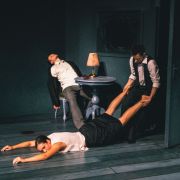
Set for four dancers, The Statement is a boardroom meeting dramatised in dance. Two employees of an unknown corporation, danced by Scott Fowler and Omani Ormskirk, are requested to come up with a statement solicited by “the guy from upstairs”, portrayed by Zenon Zubyk, whose mediation is being closely monitored by a third party embodied by Anna Bekirova.

Pite’s singular dance language is an impressive feat of blending both dance and theatre, superimposing over-the-top gesticulations that mirror the flow and intonations of speech patterns derived from the text by playwright Jonathon Young. Every shift in vocal dynamics – terse staccato-like exchanges, ramblings of manipulation or coercion – is interpolated with a corresponding physical manifestation. Pite extends this technique even further, juxtaposing her choreographic gestures with the dialogue to expose the story’s subtext. Like a duck in water, I was entertained by Zubyk’s frenetic footwork under the glossy boardroom table while from the waist up, his movements and words attempted to say otherwise.


“The guy from upstairs” has the most compelling story arc, and Zubyk wonderfully characterised a middleman who thinks he has authority but ends up being a cautionary tale. With her supple use of her spine, Bekirova captured the sinister deviousness that derives power and both Fowler and Ormskirk are a formidable, anxiety-ridden dance duo. The Statement continues to be a timely piece, successfully blurring not only the lines between dance and theatre, but art and politics as well.
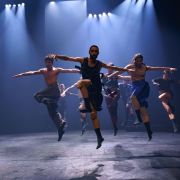
To end, NDT 1 treated the audience to yet another distinct dance dialect, this time from Marco Goecke, who like Pite, holds the title of Associate Choreographer. Danced to the music of the late Jeff Buckley, Goecke’s Woke Up Blind from 2016, embodies a kind of frenetic, beautiful urgency that is reflected in Buckley’s haunting voice and turbulent electric guitar playing. The seven dancers took to the stage like lightning in a bottle, igniting micro movements at high speed that sparked something akin to joy.

Two pairings that stuck out were Barry Gans and Chuck Jones, whose centre-stage exchange felt like bumping, molecules in an antagonistic flirtation, and Surimu Fukushi and Nicole Ishimaru, whose sharp synchronized movements made the choreography pop. Luca Tessarini expertly commanded the stage with a wild vulnerability and reckless restrain.
Ultimately, NDT 1’s Resonance was a triumphant evening. Each piece seemed to inform the next, showcasing the breadth and depth of NDT’s artistic intellect, and their dazzling versatility across various choreographic landscapes.