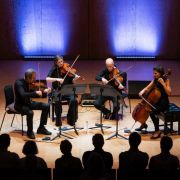
One could have been forgiven for thinking that the Carducci Quartet were still backstage, carefully tuning their instruments, when they started playing György Kurtág’s 12 Microludes for String Quartet, such was the delicate way in which they coaxed its sounds into life from silence’s invisible fabric. All of which made the loud snap pizzicato at the start of Kurtág’s third movement seem even more intense and unexpected, like a rude intervention. It set the tone for a diverse programme at the Britten Studio, part of this year’s Aldeburgh Festival, which took listeners on a vivid and varied emotional journey.

Paradoxically for a composer best known for his microscopic treatment of musical gestures and mastery of short forms, Kurtág celebrated his 100th birthday earlier this year: a long innings. Carducci’s controlled interpretation of his 12 Microludes moved from an almost Feldman-like treatment of static sounds in the sixth to fortissimo exchanges in the seventh, which appeared to distil the expressive angst of Berg’s Lyric Suite into a concentrated flourish. The propulsive open-string contractions of the eighth projected an almost Appalachian folk-like resonance.
Several years ago, Carducci benefited from working with Kurtág as part of ProQuartet’s professional training programme. The composer’s concentrated gestures were shaped with real conviction, with the quartet entirely in tune with the music’s miniaturist aesthetic.
The Carduccis are also known for their punchy performances of so-called minimalist repertoire – especially Philip Glass’ quartets – but their take on Steve Reich’s harrowing WTC 9/11 was markedly different. Given its recognisable subject matter, it would be easy to get sucked into the work’s dark sound world from the outset. They nevertheless applied considerable restraint, allowing the panic-laden anxiety of the moment to emerge through Reich’s use of pre-recorded phone beeps and fragments from air traffic control operatives.
This approach enabled the quartet to increase the intensity into the second movement, where voices from neighbourhood residents and others arriving at the scene offered sobering witness accounts of the unfolding horror. The most memorable moment came in the final movement, where the Carduccis’ plangent plainchant lines imbued the pre-recorded voices reciting Hebrew Psalms over the bodies of the deceased with poignancy and pathos. Such was the cumulative effect that one could have heard a penny drop following the final freeze-framed chord.
After the interval, Rebecca Clarke’s Adagio (Poem) for String Quartet brought a change of mood, its lyrically quiescent theme passed between the instruments as if holding a fragile jewel. Principal violinist Matthew Denton applied a deep vibrato to good effect, and the sense of growth through a series of ebbing and flowing waves was impressively conveyed. Although written a few years after Clarke’s well-known Viola Sonata, the Adagio’s ending suggested that perhaps the spectre of the First World War was still looming over the composer like a dark cloud.
After the introspection of Clarke’s Adagio, Debussy’s String Quartet in G minor at times cut through like a dazzling shaft of light. As with WTC 9/11, Carducci began in restrained fashion, enabling them to build towards an exhilarating fortissimo statement around a third of the way through the opening movement. Plenty of light and shade belonged to the second movement, its brisk tempo and punchy pizzicatos conveying its Scherzo-like nature. The third’s doucement expressif was leavened with bittersweet qualities, while the viola theme in the Un peu plus vite section was given added dignity and gravitas.
Debussy’s quartet was famously derided for its supposed “orgies of modulation”, but the Carduccis’ performance made a mockery of such taunts. By playing through the work’s stop-start tendencies and abrupt transitions – especially in the first and last movements – the quartet always kept its harmonic destination in sight. Their navigation of its circuitous pathways made the ending sound both entirely appropriate and wonderfully triumphal.