| Año de nacimiento | 1825 |
| Año de muerte | 1899 |
| Nacionalidad | Austria |
| Periodo | Romántico |


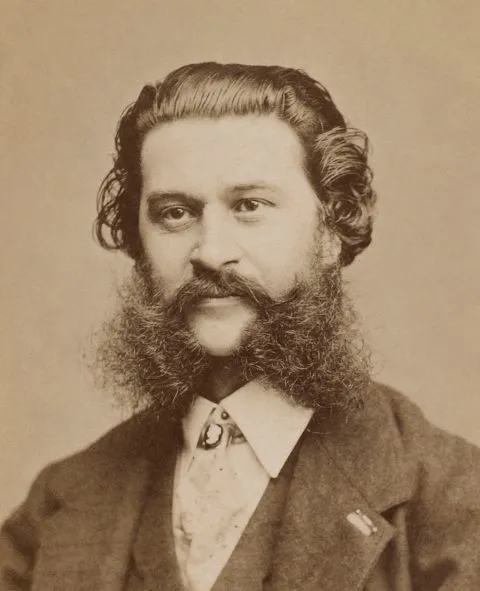
Austrian composer and best-known member of a dynasty who brought ballroom music – and the waltz in particular – to a height of sophistication and popularity in nineteenth-century Vienna.
His father, also called Johann, was himself a composer who took the waltz and other fashionable dances to new levels of professional polish, and whose orchestra, formed to perform them, achieved international renown. He is best known today for his Radetzky March. He was strongly opposed to his first son, Johann, following the same course, intending him for a career in banking, and it was only after the elder Strauss left his family in 1842 that the younger, now 17 years old, undertook formal musical training. Two years later, he gave his first concert with a new orchestra of his own, which quickly rivalled the success of his father’s, and when the latter died in 1849, the two orchestras were merged under the son’s direction.
In the ensuing decades, Strauss the Younger achieved even greater success than his father, directing his orchestra from the violin throughout most of Europe (including Russia and England) and undertaking a conducting visit to America in 1872. Feted wherever he went, he acquired an unofficial status not only as ‘king of the waltz’ but also Austria’s most influential ambassador, and in 1863 he was appointed to the post of Hofballmusikdirektor (director of the court dance-music) once held by his father. Among his musical admirers were Wagner, Brahms and Richard Strauss (no relation).
The growing popularity of operetta in Vienna led to Strauss composing his first stage works in the early 1870s, and altogether he produced 17 of these light comic operas, mostly for the Theater an der Wien in Vienna. In these, he was less successful, though at least two – Die Fledermaus (1874) and Der Zigeunerbaron (1885) – still hold their places in the repertory today.
Strauss’s achievement, building on that of his father, was to elevate dance forms such as the waltz and (to a lesser extent the polka) from their folk roots to the status they enjoy today as orchestral concert music, thanks mainly to his gift for melody, inventive variety and the broad sweep and dash with which he gathered his dances into large sets with characteristic or playful titles. The most famous include An der schönen blauen Donau (‘On the beautiful blue Danube’), Wein, Weib und Gesang (‘Wine, women and song’) and the Kaiser-Walzer (‘Emperor Waltz’).
Profile © Lindsay Kemp 2025