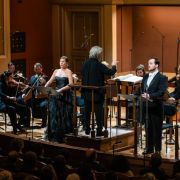
It was a reunion of sorts at the Rudolfinum, with the Czech Philharmonic bringing together a group of old friends and familiar faces for a double bill of Elgar and Stravinsky. With chief conductor Semyon Bychkov on the podium, an evening of well-worn music sounded fresh.

Sol Gabetta was the featured soloist in Elgar’s Cello Concerto in E minor, and not for the first time. She performed the piece with the orchestra several years ago and the chemistry they share was evident in the ease of the playing and seamless blend of sounds. Their styles are a good match – naturally warm and technically sharp – and their approach to a typically gloomy work was simpatico. Gabetta set a dark tone with the opening notes that the orchestra picked up in timbre and spirit, then complemented through turns of despair, resignation and hope, finally reinforcing a hammer blow finish.
Gabetta plays with an exceptional purity of tone that lent elegance to her solos. The complex runs were fierce but not overbearing, in keeping with a fine emotional balance. Gabetta went right up to the edge of pathos without falling into it, invoking powerful feelings with just a touch of cool reserve. And her segues were superb, transitioning with smooth proficiency from deeply felt sentimental lines to dazzling flashes of technical brilliance. Bychkov supported her with sensitive accompaniment, staying subdued in the sadness, brightening the livelier passages and anchoring it all with precision playing.
Gabetta’s relationship with the orchestra was in full flower in the first of two encores, as a handful of the low strings players joined her for a heartfelt performance of Gabetta’s own arrangement of the second movement of Schumann’s Five Pieces in Folk Style. The warm hugs and handshakes they exchanged afterward said it all. She returned for a captivating solo finale, a tour de force treatment of Rogelio Huguet Y Tagell’s Fandango.

A concert performance of Stravinsky’s complete score for the ballet Pulcinella brought a talented vocal trio to the stage: tenor Eric Finbarr Carey, who has toured the piece with the orchestra; bass Jongmin Park, who sang on the orchestra’s recording of Dvořák’s Stabat Mater; and mezzo Stefanie Irányi, a regular guest in Prague opera productions. All three brought entertaining expression and flair to a battle of the sexes, with their trios particularly strong.
Stravinsky’s source and inspiration for the work was a set of Italian early music manuscripts, and Bychkov pulled off a small miracle by managing to make the piece sound both Baroque and modern at the same time. Equally impressive was the wealth of details in the dances and his craftsmanship with clever touches like talking brass. Above it all the woodwinds swirled in vivid colors with dizzying momentum, offering spirited playing that combined virtuosity with exuberance. The overall effect was spontaneity and surprise, a sense that something new was unfolding and could go just about anywhere – as was the case at the 1920 premiere.
Part of that feeling came from seeing Bychkov handle a light, animated piece with such élan. During his eight seasons with the Czech Philharmonic, he has hauled around some heavy freight – recordings of the complete Tchaikovsky symphonies, explosive Mahler and Shostakovich in Prague and around the world. His skill with playful, upbeat fare offered a new perspective on his considerable talent and yet another measure of the remarkable bond he has forged with the orchestra.