For an initiative that aims to attract new audiences to classical music, publicity ahead of this concert by the Orchestra of the Age of Enlightenment was low on detail. Two short works by Vaughan Williams (The Lark Ascending and Fantasia on a Theme by Thomas Tallis) were mentioned in the blurb for a performance “where history meets cutting-edge technology, harnessing the expansive power of the Southbank Centre’s bespoke Concrete Voids system to turn the Queen Elizabeth Hall into an immersive soundscape”.

Multitudes, Concrete Voids, Squidsoup… The road to immersion (ah, that word!) was paved with modish deflections. Yet until I was handed a programme I had no idea who was conducting, nor the name of the solo violinist, nor indeed which other works were being played. Instead, the hooks for this concert were the gimmicks – a frenetic light show (Squidsoup) and amplified sound (Concrete Voids) – both of which may conceivably have made an impact on patrons sitting further back than I was.
The good news: Evan Rogister, a respected and experienced baton man, took his own work seriously and ignored the bells and whistles. It may have been a jobbing engagement for the man who’ll be conducting the OAE in Die Entführung aus dem Serail at Glyndebourne this summer, but his gleaming accounts of Warlock’s Capriol Suite, Elgar’s Serenade for Strings and the VW’s Fantasia on Greensleeves needed no enhancements to his innate sensitivity and good taste.

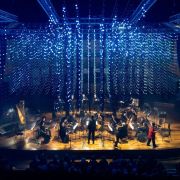
The light show was achieved by grandiose banks of suspended LED lights that chased and scuttled through assorted colours like a son et lumière of Christmas tree illuminations. The Lark Ascending, with the admirable Kati Debretzeni an itinerant soloist, was illustrated visually by shapes resembling tropical fish rather than birds in flight, or so it seemed, while the Capriol Suite’s outer movements strobed alarmingly in creative director Katherine Spencer’s abstract pictorial imagery. By the end of that second work the light bulbs had lost their novelty, so it became possible to forget the intrusions and concentrate on the music.
The English pastoral repertoire might be thought to fall outside the OAE’s bailiwick, particularly as its intended role here seems to have been as a purveyor of mood music, but the band’s playing was burnished rather than diminished by the use of period instruments. The amplification, which was no more intrusive than the enhancements that companies like Decca and Mercury used to apply 50-odd years ago to their sonic spectacular LPs, did not add undue mayhem to the proceedings and will have bothered other purists more than it did me. 70 minutes passed by agreeably enough.