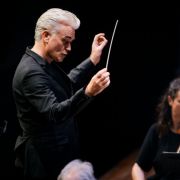
The Netherlands Radio Philharmonic Orchestra turned to British conductor Edward Gardner for their annual Christmas concert, this year a performance of Berlioz’s L’ Enfance du Christ. Joined by two dazzling choirs and an international array of soloists, but sadly without the nation’s favourite, Thomas Oliemans, who was indisposed. The full horror and emotion of Berlioz’s religious text certainly turned attention towards the deep religious significance of the Christmas story and gave cause for timely reflection.

Berlioz’s rarely performed Christmas oratorio had an interesting genesis. Originally conceived as an organ piece, it became a hit with a French public who reputedly found his usual offering a little bizarre. But Berlioz’s more accessible style didn’t just convince 19th-century audiences. One movement in particular remains a hit to this day: The Shepherd’s Farewell, found in David Willcocks' Carols for Choir 1, is sung by young and old alike all over the world. However in Gardner’s hands, the whole of Berlioz’s vivid text came alive. The full horror of Mary and Joseph’s journey to Egypt, escaping Herod’s decree to kill the newborn children, and how readily they were shunned, simply for being Jewish, was laid bare for all to heed.
A dramatic opening set the tone. Precision was the order of the day, and despite a fleeting lapse in woodwind ensemble, Gardner’s clear vision was a joy to behold. Jasurbek Khaydarov’s Polydorus, joined by an equally impressive Lucas van Lierop as his centurion, struck fear at the very heart. The horn’s trembling quiver sent shivers down the spine. As nightmarish trombones moved action inside the palace, the mood darkened. In the hands of Patrick Bolleire, Herod’s dreams of being overthrown by an innocent child felt real. And in a clever twist, his never-ending night “full of endless wailing”, ended not in terror and torment, but instead evoked empathy for a king in turmoil; complemented perfectly by the orchestral warmth.

The Netherlands Radio Choir were the undoubted stars of the evening. Initially serving as Herod’s soothsayers (fortune-tellers), the twelve male voices accompanied by trumpets and trombones were full of evil intent. No-one would dare breach their murderous flames. In Part 3, now as a Roman Chorus, the men pierced the soul as they ordered Mary and Joseph – “the loathsome Jews” – to “Be gone!” In contrast, with the ladies now on stage, their belief in God’s goodness shone through in “God be with you”, their stunning pianissimo, full of warmth and genuine hope. Bravo also to the two flutes and harp for their enthralling interlude. Their immaculate ensemble and purity were a joy.
Narrator, Robert Murray was at his most descriptive depicting Mary and Joseph’s weary journey when, as if by magic, the angelic voices of the National Children’s Choir burst forth from on high. André Morsch’s polite and respectful Father came alive at the mention of carpentry, while Florian Sempey as Joseph was at his most eloquent when expressing his love for Mary. However, even though the affection between them was palpable – Mary’s “The baby is weak; will he live?” perhaps the most operatic moment in Berlioz’s score – it prompts the question of whether certain elements should be semi-staged. Maria Warenberg’s pleading, directed entirely towards the audience, didn't quite connect with the profundity of Berlioz’s explicit text.

A deathly hush descended as ten solitary notes, one for each of Jesus’ years in Egypt, opened the Epilogue. Murray, who had reserved his most tender delivery for now, provided the emotional highlight of the evening. Matched by the choirs’ noble belief in God's wonder, Gardner delivered a thrilling finale.
This concert was promoted by AVROTROS.