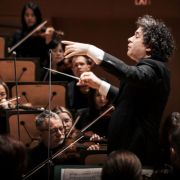
For Gustavo Dudamel, whose nearly two-decade stint at Disney Hall concludes next month, it has been something of a “hero’s life”. Arriving in Los Angeles as a still twentysomething journeyman conductor, he leaves this year as one of the most internationally recognised musicians in classical music today: an outcome worthy of a Strauss tone poem. Fittingly, Ein Heldenleben was chosen for some of the final Los Angeles Philharmonic concerts of the season; even more fitting that in this performance, tongue was kept firmly in cheek. Just as the young Strauss poked fun at his own celebrity, “The Dude”, in this swift and rhythmically pointed performance, seemed to smile wryly at his own mass media glorification.

It took a few minutes to shake “Der Held” out of bed. The opening section of the work was beset by rhythmic and textural sogginess that kept the music grounded. Only with the arrival of Des Helden Widersacher (The Hero's Adversaries) did the performance truly awaken. Philharmonic woodwinds cackled viciously, their sniping and nipping cut by stinging burps from stopped horns. All were soon overtaken by waves of silken strings, led by solo violin depicting the hero’s companion.
Conductors often enjoy making of the ensuing battle scene a forerunner to Shostakovich’s Leningrad Symphony, but Dudamel kept the mood light. This was war not as a Christopher Nolan epic, but as a Marx Brothers gag. It sounded like a drunken, mad waltz – an irate version of Lawrence Welk’s champagne music – dogpiled upon by brass outbursts and frantic strings. In the final sections, depicting the hero’s works of peace, retirement from the world and ultimate fulfillment, Dudamel wrung from the Philharmonic playing of rarified elegance and expressivity. The shimmering brilliance they conveyed in the coda achieved equal measures Weltschmerz and beatitude.

The premiere of more immediately celebratory music preceded the Strauss as the concert-opener. Admittedly, Roberto Sierra’s Estudios sinfónicos, composed for Dudamel, was more a set of estudios orquestales that depended on instrumental color rather than its intrinsic musical material, which was attractive if simple. The score, nonetheless, played to its dedicatee’s interpretive strengths; this is energetic and flashy music. Played to the hilt, it practically guarantees a standing ovation (which it did).

For all the dazzle that Sierra jams into his work, there tugs at it an unexpected melancholy. Each movement is based on Latin American dances whose outlines still evoke for Anglo audiences pleasant daydreams of docile, sunny lands of siesta and señoritas. Yet in Latin America itself, these traditional musical genres have been nearly obliterated in the 21st century by the onslaught of popular media from up north. The impression of sadness is reinforced in the final movement, Passacalle con plena, with threaded in snatches of the Argentine new-folk standard, El negro José.
As I sat and listened, I wondered if there was a message in a bottle contained in those scampering musical quotes. Perhaps that even the dance must end, but life goes on. “Ewig, ewig,” as another composer put it.