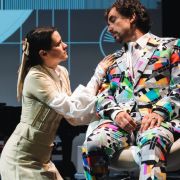
Opera plays a central role at the Accademia Musicale Chigiana in Siena, which this season presented the world premiere of The Butterfly Equation by Thomas Cornelius Desi, produced in collaboration with Musiktheatertage Wien. Thus, to celebrate Giacomo Puccini's centenary, rather than just staging one of his operas, the Chigiana draws inspiration from the composer’s legacy to support a brand new work, successfully embodying the innovative spirit infused by the artistic director Nicola Sani. No doubt this is a cornerstone in the logbook of the Accademia Chigiana.

Desi’s opera is based on Puccini's private correspondence and features an actor, five sopranos from the Mozarteum Salzburg and five pianists from the resident Chigiana Keyboard Ensemble, with stage direction by Alessio Pizzech and musical direction by the composer himself at the Teatro dei Rinnovati. The work will also be presented in September in Vienna.
This piece of théâtre d’auteur, as Desi calls it, explores Puccini’s relationships with various women in his life through their letters, delving into the dark meanders of the story of Madama Butterfly, thus becoming an exploration into the man's hidden fears and fragilities, the true motor behind human actions and interactions.

The Butterfly Equation opens as a TV talent show in which a singer must be chosen for the title role in Madama Butterfly. The candidates are five sopranos, named after Puccini’s wife Elvira, his (presumed) lovers Corinna, Giulia and Josi, and Doria Manfredi, the Puccini's maid who, unjustly accused by Elvira of adultery, committed suicide in 1909.
They are hosted and auditioned by Joy, the TV host, who introduces himself as the son of B.F. and Kate Pinkerton. Each candidate delivers her peculiar interpretation of “Un bel dì vedremo”, each differing from the other both in melodic structure and tempi: shorter or longer notes, different timbral emphasis and deeply felt interpretations give each one a distinct emotional quality, setting it apart from Puccini's aria. If the original is a hymn to hope, here it becomes the leitmotif of a lacerated memory, making Joy slip more and more into despair. In the end, Joy decides it is unlikely – if not impossible – to make a choice.

It is clear that Joy Pinkerton is the real protagonist of Desi's opera: his behaviour is enigmatic and intriguing, at the beginning very pumped and self-assured, until he starts questioning who he truly is. The plot unfolds like a dream turning into a nightmare; the women, though shy and insecure, transform into haunting ghosts of the past, while Joy is struck by an identity dissociation disorder and eventually is made aware that he is the son of Madama Butterfly herself.
Thus the opera, through a ritualistic and symbolic musical progression, with the five pianists also having an active role on the stage, guides Joy toward his inevitable fate. The images of his childhood, when he witnessed the tragic death of his mother, have left indelible marks on his mind, shaping his destiny: as the opera advances, particularly in the second act, he descends into the depth of his own disturbed psyche, to the point that he dresses and wears make-up like a geisha, and eventually kills himself with a ritual sword.

An outstanding interpretation was rendered by the actor Giuseppe Nitti as Joy, joined by promising sopranos, as well as good actresses, Olena Ertus, Laura Igl, Ami Mizuno, Anja Rechberger and Laura Thaller, each of them cleverly using different vocal techniques and singing styles.
Desi’s music is quite impressive, and far from being comforting – with echoes from Puccini's legacy – with a broad range of progressions, broken harmonies and dissonances which trigger disturbing memories culminating in the powerfully dramatic final suicide. The five pianists all mastered the eerie narrative and accompanied the insecurities of the women, providing a wide array of both standard and less standard interpretive techniques.