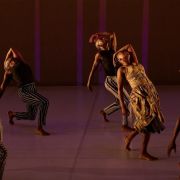
Dada Masilo sadly died in December 2024 but thankfully her spirit lives on in the passion and energy of her dancers. Hamlet premiered at ImpulsTanz Vienna in 2024, was her last choreography and again finds her tackling a classic story with her inimitable mix of wisdom and audacity. While she had always performed in her own works, for Hamlet she coached other dancers in her role as Ophelia.

The Dance Factory production includes dancers from Joburg Ballet and Moving Into Dance but mainly dancers who have worked with her previously. What they all share is presence and personality, essential qualities for Masilo who said, “I don’t take dancers into my company to be passive people.”
Hamlet is a dual role shared by dancer, Tumelo Lekana and actor, Aphiwe Dike, a troubled young man questioning his existence in Shakespeare’s words but more eloquently in movement. However, Masilo views the play from a woman’s perspective and in Lehlohonolo Madise as Ophelia she has a dancer able to get under the skin of this tragic girl manipulated by powerful men and rejected by Hamlet who might well have been a soul mate.

As Gertrude, Llewellyn Mnguni found his own way into the character. Tall and proud in a stunning gold designer dress with hair coiled high, she seemed almost above the mortal tragedy and is unable to comfort her son. The difficult relationship with her new husband, Claudius played by Thando Mgobhozi, is played out in a sensual duet with both in combative mood and in solo moments where Mnguni showed his strength in fluid emotional movement.
There is also intensity in Claudius’ repentance in the chapel. Mgobhozi gave a convincing performance as the contrite King and also showed himself a talented dancer. I wished he had been given more dance opportunities.

While there is a photo projection of an obviously European castle in the background, Masilo’s Hamlet is urban South African in character. The choreography is her trademark style of African Fusion. It needs dancers with ballet training then crafts these skills to Joburg rhythms and flavours. This maverick high-energy style has tremendous appeal and the ensemble moments are highly enjoyable. However, Masilo is equally well versed in expressing deep emotion.
Ophelia’s role is intelligently shaped and Madise is a fine dancer, one who made the character totally believable. Her troubled duet with Hamlet, both fierce and intimate, has no easy resolution. She is spied on by father, Polonius (David Maluleka) then together with brother Laertes (Thuso Lobeko) they use their masculine dominance to bully her to conform to their future plans. Ophelia is overwhelmed and with no-one to turn to, she moves to a darker space which will lead to her death. The scene, as she loses her contact with reality, is played with restraint and intensity with a voice over (Dorothy Ann Gould) reporting her death in Shakespeare’s words.

Masilo, like playwright Tom Stoppard, finds the humour in Hamlet, lurking just below the surface and she exploits it with great success. Nandi Zulu and Wesley Hlongwane play Rosenkrantz and Guildenstern then double up as Player King and Queen and are sheer delight. They enter giggling and leap-frogging over one and another like a pair of delinquent kids. They dance up a storm operating as an essential antidote to the stark tragedy.
The music, an original score from Thuthuka Sibisi with Ann Masina, Leroy Mapholo and Mpho Mothiba, incorporated elements of late English Renaissance style. However the ambiance was predominantly contemporary Africa and had most appeal in hints of vibrant Pantsula.
Dada Masilo never avoided controversy. Androgyny and gender fluidity remain constant features as they were in Shakespeare’s day, though in a somewhat different cultural context. She wanted her audiences to feel the passion and to leave the theatre with a buzz. The total commitment of the cast ensures this message still holds true.