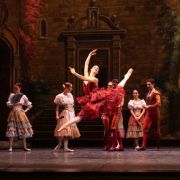
This is not the first time that José Martínez, the director of the Paris Opera Ballet has brought one of his productions to Italy. Ballet lovers may recall that his version of Le Corsaire was staged in 2023 at both the Teatro dell’Opera di Roma and the Teatro Massimo in Palermo. It is the latter that we return today to discover another of his creations: Don Quichotte, premiering in a new production as part of an international co-production with the Opéra National de Bordeaux, where it will be performed next summer.

Martínez’ version, which has been among his most iconic creations for over a decade, returns today to showcase its strengths while largely preserving the story of the two young protagonists and the well-known dreamer. In this way, he approaches the narrative of Minkus’ ballet, envisioning a production that recalls the original 19th century choreography while also acknowledging some of the notable 20th century versions. While the overall dramaturgy and choreography remain largely intact, certain elements make this production original. “I wanted to give a more poetic nuance to the character of Don Quichotte and his pursuit of the perfect love embodied by Dulcinea”, explains the choreographer. “And at the same time, I aimed to get as close as possible to the essence of Spanish dance and to the culture and traditions of my country.”

In Palermo, we are thus presented with a carefully balanced and well-structured ballet that highlights the strengths of the city’s revitalised dance company. At the premiere, it was a true pleasure to see one of the troupe’s best dancers: Martina Pasinotti — a mainstay in Palermo for over seven years — bringing dexterity and technical ease to the role of Kitri throughout the performance, concluding the work with unwavering poise and perfect balance. By her side, the dashing Michele Morelli delivered his Basilio with polish and unwavering vigour. A minor slip in the third-act variation did little to affect his overall strong technical performance.

In this production, the Queen of the Dryads is absent, and the role of Dulcinea was performed by Carla Del Sorbo, a dancer recently recruited by the Palermo company, who brings an airy quality to the character’s dreamy and gentle features. Diego Mulone shines as Espada, performing with the acclaimed Aurora Mostacci, and bringing his characteristic vivacity and robust masculine energy to the role. Andrea Mocciardini was diligent in the role of Gamache, though his character in this version lacks the irresistibly comic charm one might expect. The male and female corps de ballet stood out throughout the performance, alternating between moments of brightness, strength and subtlety.
This brand-new production is a delight on all fronts. Antonella Conte’s traditionally styled sets effectively highlight the literary theme at the heart of the ballet. Framing the scenes in the hidalgo’s library, reflecting his boundless passion for reading, works particularly well, as does the nod to the knight-errant’s travels in certain settings. Seen in this context, the second act scenery, featuring the Dryads against an evocative starry sky, is particularly striking. Mario Celentano’s costumes are elegant and understated, perfectly complementing the sets. Mojca Lavrenčič conducts with precision, masterfully maintaining perfect harmony with the dancers on stage.

With this new ballet joining the repertoire of the Teatro Massimo di Palermo’s dance company, Jean-Sébastien Colau, the company’s director, continues his outstanding work of rejuvenating and strengthening the theatre’s choreographic offerings. Today, the corps de ballet approaches Minkus’ ballet with brilliance and ease, confirming the troupe as a significant reference point in the Italian dance scene. What is now needed, however, is to proceed as soon as possible with appointments and promotions among the Palermo dancers, in order to provide the company’s ranks with a fully structured and complete framework.
Vito Lentini’s trip was funded by Fondazione Teatro Massimo di Palermo