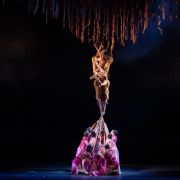
Flora is a landmark full-length collaboration between The Australian Ballet and Bangarra Dance Theatre, marking the first time the companies have created a major work together on this scale and their fourth partnership overall. The work explores the evolution and resilience of Australian flora as a metaphor for the history of the land and its people. Drawing on 65,000 years of Aboriginal and Torres Strait Islander connection to Country, Flora examines environmental change, cultural continuity and the impact of colonisation.

Choreographed by Bangarra Artistic Director Frances Rings, the production brings together more than 35 dancers from both companies. Rings handpicked 19 classical ballet dancers from The Australian Ballet whose physicality could marry the power of Bangarra storytelling. At this point it may be trite to say that Rings has a good eye, or perhaps another sense, for fostering embodied and truthful dancers, but in Flora that instinct is unmistakable. The Bangarra movement is incredibly nuanced, earthed, and fluid – a style not always easily embraced by structured classical ballet dancers. Yet, in Flora, the performers move as one, with The Australian Ballet dancers melding impressively into Indigenous storytelling.

Flora opens with a stripped back palette: it is origin territory, old and elemental – earth, roots and ancestry. Dancers hang from the roof in geographical colours, evoking a subterranean and exposed root system pulled taut between earth and sky. Narrow beams of cool, blue-white light cut through the darkness, like moonlight filtering through a canopy. It’s ceremonial, gathering energy. Then come the colonisers: red-coated, pale and pestilent, their movements jagged and spasmodic like a zombie apocalypse; clothes torn and blue and bloodied; cloven hooves trampling the ground.
The production features an original score by William Barton, blending Indigenous instruments with Western orchestration, alongside extraordinary costumes by Grace Lillian Lee with Jennifer Irwin, set design by Elizabeth Gadsby, lighting by Karen Norris and cultural consultancy from Matthew Doyle. Together, these elements support a work that situates ecological and cultural history within a shared artistic language.

Barton’s score is soaring and beautiful, sections thrumming with bird calls and didgeridoo. At times, for me, the orchestral sections lean slightly too ‘Disney Princess’ to match the primal power of Bangarra movement: Exhibit A – Chantelle Lee Lockhart is a take-no-prisoners, tectonic plate of a dancer whose barrelling head rolls a tsunami down her body, shifting the metaphorical continents of performer and audience. Exhibit B – Daniel Mateo, named as one of Bachtrack’s Rising Stars to watch in 2025, shows no difficulty translating his enormous talents to the Opera House stage.

Act 2 opens with a hothouse of dancers stripped of landscape; they pose inside translucent white cylinders, evenly spaced, under stark, neutral light. This is post-invasion and institutional white – beautiful, preserved, isolated and breathless. Colonialism reaches its zenith when a black dress descends from above onto dancer Jill Ogai, whose strengths could not be more suited to this collaboration. Ogai performs a mournful, haunting solo, as the text of the now repealed section 127 of the Australian Constitution strips the stage with stark black-letter print, declaring that Indigenous Australians were to be excluded from the national population count.

Given that the catalyst for regeneration is fire, I was hoping for more power from that section. Instead – although undeniably building – it initially felt slightly kitsch: the equivalent of a digital fireplace with an LED flame effect, all visual and no heat, failing to approach the roaring, cyclonic force of an Australian bushfire. To be fair, live flames on sticks were marched across the stage, but they mainly induced mild panic in me, knowing how hard it is to exit the Sydney Opera House on an opening night, even in the most controlled operating environment. For a moment, I worried we were about to have a reenactment of the devastating Iroquois Theatre Fire of 1903 (think flammable scenery, poor ventilation, staff untrained to use fire equipment, 603 dead).

Mercifully, any deficiencies in the destruction portion of the evening are more than forgiven by what follows: Bangarra dancer Courtney Radford reclines in a single downlight against the crackling of embers. Now comes the regeneration, the renewal, the bloom and it is worth the wait. Moving with exquisite integrity and aching limbs, Radford fills the space as soaring liturgical vocals rise around her, calling out to hope after devastation and colour after darkness. A semi-circle of gorgeous dancers in high-saturation jewel and tropical tones worship around her – a spectrum of deep raspberries, crimson reds, violets, marigolds – all floral and regenerative and unmistakably alive.
Flora is a beautiful, ambitious and triumphant partnership – a work of striking visual beauty, emotional force, and an infinite song of survival and renewal.