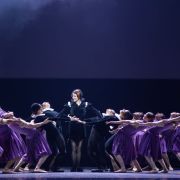
Nearly 450 years since her death, Mary, Queen of Scots continues to fascinate the public. Executed at Fotheringhay Castle in 1587 on – apparently – the orders of her cousin, Queen Elizabeth I, against whom she had been conspiring whilst imprisoned in England, Mary’s turbulent and tragic life story has inspired countless biographies and novels, plays written by Schiller and Liz Lochhead, operas composed by Donizetti and Thea Musgrave, and Hollywood films starring Katharine Hepburn, Vanessa Redgrave and Saoirse Ronan.

Much is known about Mary’s life, but with the passing of time her legend has been embellished and reimagined so frequently her history has become reinterpreted to suit current day thinking. For Schiller and Donizetti, working in the first half of the 19th century, she was a much-wronged romantic heroine; in the 2018 movie she is a tolerant, liberal, gay-friendly, modern-minded monarch, and in the 2022 television drama The Serpent Queen she is portrayed as a religious fanatic and a simpleton.
The figure of Mary has even appeared in dance, where contrasting works have ranged from a duet made by Martha Graham in 1959 to a full-length narrative ballet that Peter Darrell created for Scottish Ballet in 1976. Despite its Scottish theme, Darrell’s ballet did not last long in the company’s repertoire, and rather than attempt to revive that work 50 years later, Scottish Ballet’s artistic director, Christopher Hampson, sensibly commissioned a new Mary, Queen of Scots from its talented resident choreographer Sophie Laplane, danced to a new score composed by Mikael Karlsson and Michael P Atkinson, and co-directed by James Bonas.

The production has been given a modern styling by the choreographer and her team. Designer Soutra Gilmour has created punk and New Romantic-style costumes that hint at 16th century fashions and provided a set of simple blank walls that can be raised and lowered to indicate changes of location. The clever projections and shadowy effects are by lighting designer Bonnie Beecher and projection and video designer Anouar Brissel, and the score is pleasingly reminiscent of film music by Michael Nyman. There is gender-neutral casting, too, with guest artist Charlotta Öfverholm and Harvey Littlefield sharing the role of Queen Elizabeth, and Madeline Squire portraying Catherine de’ Medici and Mary’s son, King James I. Mary, Queen of Scots has a lot going for it, so it pains me to admit that my initial reaction to the ballet is one of disappointment.

Although the ballet follows the broad outlines of Mary’s story, the choreographer is keen to point out that the work is “non-historical ballet”, and there are key moments from her life – such as Mary’s marriage to Lord Bothwell – that have not been included. Events unfold with rapidity, but they are often simplistically told and allow little time for reflection and consideration. In addition, Mary (danced by the accomplished, poised Roseanna Leney) too often lacks agency and becomes a woman to whom things simply happen. Moreover, Laplane has not given Mary a distinctive choreographic vocabulary to help delineate and define her character. There are duets with her husbands, first King Francis II of France, and then Lord Darnley, and Mary is also seen with her companions, David Rizzio and the Four Marys, but their brevity means their dances lack significance. Indeed, the most passionate sections of the ballet – the homosexual pas de deux between Darnley and Rizzio in Act 1, and the intriguingly supportive duet between the Proxies for Mary and Elizabeth in Act 2 – do not include the “real” Mary at all.

Although she never met Mary, Queen Elizabeth I figures prominently throughout the ballet and is given much more emotionally explicit choreography (I did wonder whether Laplane had found her the more interesting woman?). Öfverholm offered a riveting physical performance as the doddering Elizabeth at the end of her life, remembering the events that shaped her reign. Towering above the rest of the cast, and wearing a doublet, corset, ruff and long red wig, I was less convinced by Littlefield’s impersonation of the Queen and found it difficult to reconcile the two dancers as the same person.

Other characters – such as Bruno Micchiardi’s ebullient Rizzio and Evan Loudon’s handsome, yet appalling Darnley – don’t have the choreographic “meat” to make an impact, and I would dispense entirely with the role of the evil Jester, even though wonderfully portrayed by Kayla-Maree Tarantolo. A niggling thought also kept occurring to me throughout the ballet: If you didn’t know anything about Mary, Queen of Scots, would you even understand what was unfolding on stage?

The ballet ends with Mary’s execution, but – unlike the final scene in Donizetti’s Maria Stuarda, for example – Laplane is in such a hurry to bring the ballet to an end there is no catharsis, and no sense of a life lost. It is an underwhelming conclusion, but, like Mary’s strangely prescient personal motto, “In my end is my beginning”, I suspect all is not lost for Laplane. She needs the opportunity to take stock, review and rethink a work that has the potential to become something special.