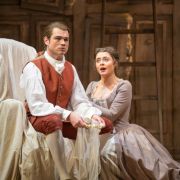
I fondly remember Kirill Serebrennikov’s busy banks of spinning washing machines at the 2024 Edinburgh Festival Marriage of Figaro, a haunting image from the most recent outing of the opera in Scotland. Not everyone was enamoured, so Scottish Opera’s revival of Sir Thomas Allen’s 2010 production, a solidly traditional period piece, will be a genuine and welcome crowd pleaser, the director back in Glasgow to keep things sharp. This third run of the production, in English for the first time, uses Amanda Holden’s earthy English libretto, helping to clarify Pierre Beaumarchais’ convoluted story in what, for many, can be their gateway opera experience.

From beginning to end, it looks gorgeous, designer Simon Higlett’s muted ivories and amber colour palettes stunningly and atmospherically lit by Mark Jonathan, setting the scene with wheat sheaves in a golden hazy autumn moving onto pastel bleached interiors. Ruth McLean’s costume team creations are so tastefully beautiful and elegant that if Mozart himself had wandered onstage, he would have blended in perfectly. Allen brings his deep knowledge of the opera to achieve the balance of humour with the more serious business of a master and servant household wracked with sexual tension. His uncluttered storytelling, memorable vignettes and directing are superb, making farce look as easy as falling out of a window.
We meet Figaro assembling his rickety bed which has just arrived in bits off a dusty wagon. He is in his newly assigned bedroom – between the Count Almavira and Countess – much to the disgust of Susanna who knows the game of droit du seigneur is afoot. These central roles were robustly sung and deftly acted, Edward Jowle’s burnished bass-baritone, authoritarian and confident singing his first Figaro, breaking the fourth wall in the final act, challenging the audience (house lights up) in his aria “Aprite un po' quegl'occhi”. Alexandra Lowe’s beguiling soprano pulled off the Countess’ well-paced aria “Dove sono”, a splendid foil to Ian Rucker’s rich, textured Count, a wonderful company debut. Ava Dodd, also new to Scottish Opera, was pivotal as a wise and knowing Susanna, her enthusiastic bright soprano never wavering.

Simone McIntosh’s Cherubino was a volcanic eruption of young teen infatuation, unpredictable and joyously complicit in the shenanigans to teach the Count his lesson, her delightful easy flowing mezzo exuberantly stealing the show. In the singing, I enjoyed the attention to detail with light ornamentation in the arias and with recitatives augmented by a mischievously witty Toby Hession relishing oodles of inventive fun on piano continuo.
While the main characters scheme, the lesser roles have their essential place in the tale. Edward Hawkins as Doctor Bartolo and Jeni Bern as his former housekeeper Marcellina made a compelling couple. Scottish Opera emerging artists Luvo Maranti ably doubled as Don Basilio and Don Curzio, and Kira Kaplan was a spirited Barbarina, with top comedic marks going to Francis Church as the gardener, spoiling the well-laid Act 2 plans with his broken flowerpot. The chorus sang and acted perfectly, Kally-Lloyd Jones directing movement and choreography with minute attention to detail, including several characterful children. The set dance in Act 3 was a show-stopping visual feast of swishing costumes, courtly gestures moving in harmony, all bathed in golden light.

Details can really make a production: Allen recognises the Count as a military man, sending Cherubino off to join his regiment, so the Count has a collection of hand-painted soldiers on display in Act 3. The stage business with notes and pins was done well, as was the general eavesdropping, the return of the wheat sheaves for the denouement in the garden scene giving plenty of concealment opportunities. The ghost child crossing the stage diagonally in the Countess’ “Porgi, amor” added intrigue.
In the pit, conductor Dane Lam set a brisk pace in the overture, the natural horns and trumpets adding period flavour. With a sizeable band and most players in front of rather than underneath the stage, winds at the side, occasionally Lam’s enthusiasm rather overtook the singers, but with effervescent strings and characterful winds, the balance and timings were generally sound, allowing the singers space.

There seemed to be rather too many applause opportunities, which the enthusiastic Glasgow audience certainly embraced, but sometimes the action deserved to move on without interruption. I am still undecided on Holden’s translation which rather underlines the story in red ink and might even have had Mozart blushing at times, however carefully they were fitted to his music. I concede that they helped the audience understand this big bold show, which deserves to do well as it tours Scotland.