At a time when musical experiences are often filtered through online media – whether via broadcasts, livestreams, or social media – the uniqueness of place and setting cannot be overstated. As Benjamin Britten himself once suggested, only by visiting a place does one begin to appreciate its roots, understand its associations and make sense of its backgrounds and personal relationships. This is certainly the case for anyone attending the Aldeburgh Festival, which Britten co-founded in 1948. Audiences flock to the festival primarily for its awe-inspiring performances, but they often leave with so much more, having experienced Snape Maltings’ idyllic setting, peaceful atmosphere and magical aura.

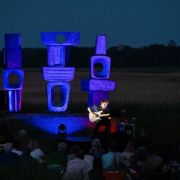
And so it was with guitarist Sean Shibe’s electrifying alfresco concert. Held on Hepworth Lawn – within touching distance of the River Alde estuary and its abundant wildlife and against the imposing backdrop of Barbara Hepworth’s sculpture The Family of Man – the sounds of Shibe’s electric guitar sneaked in unannounced while friends and family were still chatting, with Olivier Messiaen’s O sacrum convivium! Originally written for choir with ad libitum organ, Shibe’s enigmatic arrangement made Messiaen sound more like freeform Mike Stern than a sacred setting. One imagines, however, that the French composer would have appreciated the spontaneous birdcalls heard above the music’s measured cadences.
Julia Wolfe’s LAD offered a very different transcendent experience, its heavily drone-drenched wall of distorted sound more heavy metal Xenakis than jazz fusion Messiaen. Shibe’s impeccable control of the e-bow produced ever-spiralling cascades of slowly rising and sustained pitch bends. His Fender Stratocaster forever straining at the feedback leash, the overall effect of these grief-laden, wailing glissandos was curiously cathartic.
After another arrangement, this time Hildegard of Bingen’s votive antiphon O choruscans lux stellarum – its plainsong-like incipits wafting through the evening air like dandelion clocks – Shibe segued effortlessly into Steve Reich’s three-movement Electric Counterpoint. For live electric guitar and tape, the opening pulsing chords of Reich’s 15-minute composition seemed to reshape the open-air space. Shibe’s clean, balanced sound was reminiscent of Pat Metheny’s original Nonesuch recording but clothed in a cool Classical sensibility. Plenty of energy was nevertheless exerted during the final section, its restlessly ricocheting basslines underpinning a mosaic of infectiously interlocking melodic hooks floating above.

If Electric Counterpoint was the evening’s centrepiece, Shibe’s transcription of Meredith Monk’s beautiful Nightfall was undoubtedly its highlight. The work’s slowly unfolding bass loop and delicately probing interweaving textures enveloped the area as dusk settled over Hepworth Lawn, its totemic sculptures suddenly bathed in a purple glow.
Julius Eastman sang with Monk’s vocal ensemble during the early 1980s before his life was tragically cut short a decade or so later at the age of just 49. Neglected for decades, his music has recently enjoyed an upsurge in popularity through the efforts of musicians like Shibe. So much for conceptual continuity connecting Eastman to Monk, however: unlike the immersive tones of Nightfall, Eastman’s Buddha reverberated with the low rumble of a huge airport hangar, a kind of Ur-Om one might imagine a colossal Buddha figure such as Tian Tan Buddha on Lantau Island, Hong Kong, emitting.

And at that moment, Eastman’s powerfully crafted aural sculpture got me thinking again about the significance of place. There are multiple reasons – financial, practical, logistical, health, personal or professional – that prevent us from attending a particular event, and at those times the radio, television, laptop and internet can be valuable companions. But nothing beats being present in a moment when something beyond the sum of its musical and visual parts is experienced – something unique, vital, unmatchable and irreplaceable.