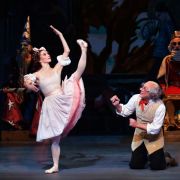
Philadelphia Ballet’s The Merry Widow waltzed into the Academy of Music on Thursday, meticulously recreating 1900s Belle Époque Paris. Alongside Beatrice Jona Affron’s flawless conducting of the Franz Lehár score, Ronald Hynd’s choreography, originally set on The Australian Ballet in 1975, offered a tasteful, elegantly performed spectacle of traditional folk dances, sweeping waltzes and romantic pas de deux, culminating in a grand finale at Maxim’s.

In Act 1 of this romantic comedy, the fictional Balkan state of Pontevedro is about to go bankrupt and officials at its Parisian embassy are scrambling to avert a crisis. In a comedic, vaudevillian “paper-shuffle” dance, they determine that the wealthy widow Hanna must marry a local to save the state’s finances. Count Danilo (Sterling Baca) is chosen for the task, stumbling back from the bars to perform a bumbling, drunken mazurka. Upon learning he must woo Hanna at that evening's ball, he toasts the news with more champagne. Throughout, Baca and the ensemble displayed both technical precision and the comedic acting chops required for their roles.


Meanwhile, the young Valencienne (Yuka Iseda) is dallying with French attaché Camille (Ashton Roxander) behind the back of her elderly husband, Baron Zeta (Charles Askegard). Iseda and Roxander’s undeniable chemistry shines in the first of several exquisite pas de deux.
A scrim lifts to reveal a sea of couples in glittering champagne gowns and sharp jackets waltzing beneath candlelit chandeliers. The choreography blends Viennese elegance with Spanish flair, executed by the dancers with great polish and refinement. Still mildly intoxicated, Danilo quickly sobers up given the sheer physical demands of his solo allegro; this he delivered with buoyancy and smooth sophistication.

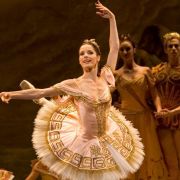
Hanna (an exquisite Mayara Pineiro) arrives as the belle of the ball, descending a staircase in a glistening black gown, feathered fan and blinding tiara (Roberta Guidi di Bagno’s fabulous designs shine throughout the production). Pineiro’s radiance defies any sense of mourning.
Notably, Dame Margot Fonteyn performed this role at age 57 with the Australian Ballet in 1976 — one of her final full-length performances.
Hanna initially dismisses Danilo upon their reunion. The stage dims to a soft blue light for a flashback of the two as secret lovers. They dance with youthful freedom, Danilo indulgently spinning her as she balances precariously upon one slender, pointed foot.

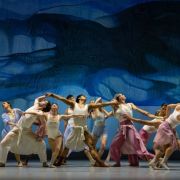
Back at the ball, more champagne flows. As the women whirl, grands battements help shape their gowns into inverted champagne flutes. The men carry the women across the room like floating musical notes from Lehár’s score. When the men – including Camille – vie for Hanna’s attention, Valencienne descends into an amusing tantrum, her grace dissolving into exasperation with clenched fists, furrowed brow and stomping feet.
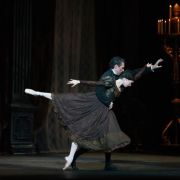
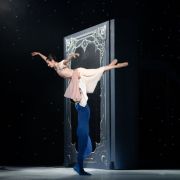
A sober Danilo and a softening Hanna share a gorgeous waltz; he lifts her overhead and she corkscrews down his body in tender rotations. In an echo of their younger selves, she repeats her precarious balance on a single pointe, leaning impetuously away from Danilo as he steadies her expertly.


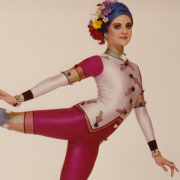
Act 2 shifts to Hanna’s moonlit garden, showcasing virtuosity through elaborate folk dances. In traditional folk attire with fuschia accents and tasseled hats, the male ensemble performs dances of intertwined circles and canons featuring fast-paced footwork, leg slapping and jumps. Zecheng Liang delivered an outstanding solo, channeling traditional legényes with impressive vertical, single-leg jumps.
Pineiro offers a sassy solo, kicking a flexed foot up in Danilo’s direction in a playful nod to his past rejection. Hijinks follow: after a gravity-defying pas de deux, Valencienne and Camille hide in a gazebo. To shield them from the Baron, Hanna secretly swaps places with Valencienne. When the doors opened, she and Camille appear to be lovers; believing the ruse, Danilo flies into a rage, proving his enduring love for Hanna. The action-packed sequence was delivered with a perfect mix of physical comedy and dramatic flair.

Act 3 brings the production to Maxim’s, where champagne-fueled opulence resolves the previous acts’ antics. Amidst fiery can-can dancers, sleek gowns, top hats and double breasted tailcoats, Hanna appears like a nocturnal vision in pale blue, her intricately plumed scarf creating a celestial, cascading halo around her, reminiscent of Alphonse Mucha’s The Moon. In contrast, Valencienne glows in golden hues like Mucha’s Morning Star. After Baron Zeta gracefully relinquishes his wife to Camille, a marvelous pas de quatre unfolds. Danilo and Camille fluidly turn their partners above their heads like celestial bodies, the women's long, graceful arms extended in seemingly perpetual motion.
A fabulous, detail-rich production from start to finish, The Merry Widow runs through March 15.