What are the chances of two unrelated concerts, held nine days apart, both announcing themselves as ‘Echoes of…’ and including Elgar’s Serenade for Strings in their programmes? Unlike ‘Echoes of the High Hills’, the Orchestra of the Age of Enlightenment’s QEH ‘immersion’, the performance at Wilton’s Music Hall by Chromatica Orchestra came unencumbered by flashing lights. Their unpretentious concert, ‘Echoes of Albion’, was not one for the Multitudes; rather, it was an evening for anyone who enjoys hearing music delivered with uncluttered sincerity.

The young professionals of this fresh-sounding string orchestra played Elgar’s Serenade for their conductor, Tess Jackson, with commitment and no little virtuosity. Occasional slips of ensemble and intonation mattered less than their passionate performance. The central Larghetto, for example, recovered from a flaky start to sing with near-numinous intensity by the end.
Composer Freya Waley-Cohen’s Talisman, a work for string orchestra of comparable duration to Elgar’s, has the valuable quality of drawing the listener to somewhere other. Where that ‘other’ might be is of little importance if we choose to experience the work as an expression of purely musical thought, yet the composer’s note imposes so many overt intentions on her composition that listeners might feel they’re letting her down if they miss her clues. That would be unfortunate because while the ideas themselves have originality, their substance is subsumed into a kind of aural art installation. It is descriptive rather than meditative, music that’s easier to admire than to engage with.
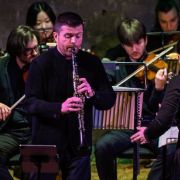
Julian Bliss joined the orchestra for Finzi’s gorgeous Clarinet Concerto, a work of astringent sweetness whose tart harmonies bridge the space between Vaughan Williams and Britten. The orchestral introduction builds on lush chordal clashes in the thick string writing, through which the clarinettist’s first entry cut with crystalline clarity. Bliss played as usual with impeccable technical command and beauty of tone, although there were moments in this most rhapsodic of concertos that would have benefited from a touch more physical clout. Jackson might have helped him by finding more of a story for the orchestra to tell, rather than beating out the score note by note.

This tendency also hampered the opening minutes of Britten’s Variations on a Theme of Frank Bridge when, rather than feel the music’s rhythm, the players were expected to mirror the conductor's every beat. If musicians who play this score cannot play with freedom they are likely to make more ensemble slips rather than fewer. As it was, Jackson’s reluctance to grant them an expressive canvas reduced their role to the musical equivalent of painting by numbers until, almost magically, a point arrived midway through when everything clicked and the music took flight. Cellos and double basses led the way with punch and power, violins and violas became a choir of complementary voices and the home straight delivered the kind of excitement that had always threatened to break through.