The Chigiana International Festival opened its 2026 edition with a bold artistic statement. Under the theme Isole (Islands), Artistic Director Nicola Sani has built the festival around Hans Werner Henze’s centenary, placing the composer at the heart of one of the most ambitious retrospectives devoted to a single figure presented in Italy in recent years. Choosing Henze’s Requiem to launch the festival was therefore more than a commemorative gesture: it was an invitation to reconsider one of the twentieth century’s most independent musical voices.

Written between 1990 and 1992, the Requiem is neither a conventional Mass for the Dead nor an orchestral concerto. Henze dispenses entirely with voices while retaining liturgical titles – Introitus, Dies irae, Rex tremendae, Tuba mirum, Lacrimosa – entrusting their expressive function to piano, trumpet and chamber orchestra. The result is music that seems to speak without words, allowing instrumental colour, rhythm and gesture to carry the emotional and spiritual weight normally assigned to text.
The Church of Sant’Agostino proved an ideal venue, its resonant acoustic reinforcing the work’s ritual dimension without diminishing its dramatic edge. Particularly compelling was the Rex tremendae, where Belgian trumpeter Jeroen Berwaerts gave a commanding account of Henze’s formidable solo part. Combining technical brilliance with remarkable expressive range, he moved effortlessly between lyrical introspection and biting rhetorical power. His incisive fanfares evoked the authoritarian voice that Henze associated with totalitarian propaganda, while the orchestra’s fragmented responses transformed the movement into an unsettling act of historical remembrance rather than mere musical illustration.

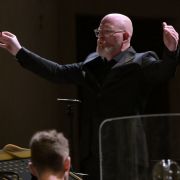
Kai Röhrig conducted the Orchestra della Toscana and the Chigiana Percussion Ensemble, with outstanding contributions from two leading interpreters of contemporary music, Berwaerts and pianist Emanuele Arciuli, alongside Vittoria Di Grazia, Angelo Maggi and Davide Traina. Röhrig’s conducting was central to the performance’s success. Henze’s score unfolds as nine independent ‘sacred concertos’, each with its own character, tempo and dramatic trajectory. The danger is fragmentation. Instead, Röhrig revealed the architecture that binds these disparate episodes together, allowing sharp contrasts to coexist within a convincing overarching narrative. He resisted smoothing over abrupt changes of mood, recognising that the work’s unity is ethical rather than stylistic.
The concert also demonstrated something that recordings cannot entirely convey. Henze’s intricate rhythmic language, sudden interruptions and constantly shifting tempi can seem elusive on disc, where listeners are left to reconstruct the music’s internal pulse for themselves. In live performance, however, the conductor’s gesture becomes part of the listening experience. Röhrig’s firm control of pulse and carefully judged transitions made the work’s temporal architecture visible as well as audible, enabling the audience to perceive a coherence that can easily remain hidden in recorded performances. Contemporary music often demands an active mode of listening; here, the visual dimension of conducting became an essential interpretative tool.

Arciuli, one of today’s foremost interpreters of contemporary repertoire, approached the solo piano part with characteristic clarity and quiet authority. Rather than projecting the piano as a virtuoso protagonist, he integrated it seamlessly into Henze’s orchestral discourse, shaping its constantly shifting roles with precision, sensitivity and an acute sense of balance, illuminating the score’s expressive subtlety without ever compromising its structural integrity.
The festival’s extensive Henze focus also reflects the Chigiana’s dual identity as both festival and academy. By immersing young musicians in the composer’s music throughout the summer, it cultivates the listening discipline required to engage with contemporary musical language – not as an academic obligation, but as a living artistic experience. In performance, works that may initially seem opaque reveal an underlying coherence that neither recordings nor the printed score can fully communicate.
Dedicated to the memory of Michael Vyner, the London Sinfonietta’s artistic director who died from an AIDS-related illness in 1989, Henze’s Requiem transforms personal grief into a broader meditation on mortality, violence and remembrance. Opening the Chigiana Festival with this uncompromising work was therefore not simply an anniversary tribute, but a declaration that challenging music can still speak directly to contemporary audiences. On this evidence, the festival’s extensive Henze focus promises to be far more than a centenary celebration.
Lorenzo's press trip was funded by the Chigiana International Festival