The annual Next Generation Festival at the Linbury is a perfect opportunity for talent spotting: top vocational schools and junior companies performing varied programmes, some appearing for the first time in the UK. It’s not just interesting – it’s incredibly exciting.

English National Ballet School and the John Cranko Schule from Stuttgart shared a very diverse evening of works that seemed to complement each other wonderfully well. It was also my preferred option to see the schools alternating across the programme rather than one half being given to each school.
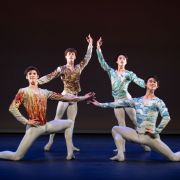
It was brave to open with Anton Dolin’s Variations for Four (for the men) created in 1957, followed by his Pas de Quatre (for the women), which he reconstructed in 1941. The choreography is extremely challenging for both pieces and there’s no place to hide even the tiniest of wobbles.

The JCS got off to a cracking start with a display of virtuosic dancing. Cameron Cinnamond-Bland, Kenshin Kimura, Keisuke Miyazaki and Simon Tischler each gave very polished accounts of their solos and duets but even better, they managed to remain perfectly in sync when dancing together, right up until the spectacular end in a series of turns à la seconde. Kimura especially produced impeccable pirouettes, a breathtaking series of coupé jetés en tournant, beautiful lines and all with warmth and charm. It's onwards and upwards for him.
ENBS presented the Pas de Quatre with all the requisite Romantic style. It may be too saccharine for some but I think they just got stuck in and embodied the period with unforced quality. It is another piece which disguises the complexities of petit allegro and batterie – and stamina – by allowing the viewer to focus on the softness of the port de bras. Annabel Foster, Hana Toyama, Mei Abe and a very lovely Lyla Ireland, all did well with what is undeniably a piece created for top stars, not students.

After the interval the fireworks really began. Demis Volpi’s Winter for ENBS was a fabulous example of students embracing and investing in the style and vocabulary of a particular choreographer. Set to Vivaldi’s Four Seasons, it worked on every level. Volpi gave the dancers unbelievably fluid combinations of solo and double work. Every shape was clear cut, etched on languorous limbs, expressing the music with absolute clarity. I loved the ending when the cast of six seemed to melt into the floor, a symbolic thawing of the ice. Sophie Carter and Rio Barker, both of whom I remember well from previous productions, were particularly striking.
Wiktoria Kielbasinska from JCS gave an extraordinary account of Xenia Wiest’s solo At Last to Etta James’ song of the same name. Reflecting on heartbreak and recovery from it, immensely talented Kielbasinska carried the weight of it with maturity and honesty.

Bridget Breiner’s Fleeting for ENBS was the second gentle reminder (Volpi was the first) that we do not see enough of choreographers whose work is everywhere in Europe but rarely, if at all, seen in the UK. Set to music by Anton Rubenstein, words by Mirza Shafi and sung by Boris Shtokolov, it was powerfully danced by Elisabeth Schemel, Katie Betz and Viviana Guemez. It can be difficult to portray emotion and deep nostalgia in a brief interlude but they were right there, in the moment.
Macie Miersch from JCS was utterly captivating in a solo choreographed by Jordan Pelliteri called When Light and Dark Meet. Fundamentally referencing the resilience of human nature, it was highly original and sufficiently quirky to really make its mark within a strong programme.

The programme ended with Marco Goecke’s All Long Dem Day, set to Nina Simone’s Sinnerman. Suffice to say, JCS delivered a corker. Goecke has a whole set of movements that simply couldn’t have been created by anyone else. Fast-paced, febrile, jerky, frenetic and hugely impactful – within a large cast, it was hard to believe that these dancers were not well-oiled professionals. The overriding impression was that no matter how fast they were required to execute any given step, it still had to be done ‘large’: feet, legs, arms, crazy head movements, at full pelt.
It was an exciting and dramatic ending to what was ultimately a very palatable evening with something for every taste.