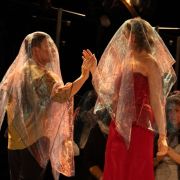
A princess slumbers placidly for a century, woken only by a stranger’s kiss. Sound familiar? Sleepers Awake, the new work by Gregory Spears receiving its world premiere at Opera Philadelphia, embraces the Sleeping Beauty trope while simultaneously subverting it. That duality could serve as a metaphor for the entire opera, which musically mashes up lush Romanticism and wispy mysticism, and dramaturgically infuses the world of fairy tales with a sardonic edge. It’s an ambitious undertaking – a chamber piece presented on a grand scale – but one that doesn’t entirely cohere.

In this telling, not only is the princess cursed with endless repose, but her entire court must also nap beside her. (A reverse Turandot, perhaps?) This structure allows for the chorus to take a central role in the storytelling, and to offer a contrast to Thorn Rose (Susanne Burgess), who seems none too pleased to be woken by a man. The character of The Stranger (Jonghyun Park), a princely stand-in, comes across more as a ponderous poet than a swashbuckling royal swain in want of a wife. For 90 minutes, the pair consider the nature of love and reality, while the chorus forms a sort of internal monologue, expressing the emotions the characters cannot seem to verbalize themselves.
Spears adapted his libretto from the writings of Philipp Nicolai (1556-1608), Arthur Quiller-Couch (1863-1944) and Robert Walser (1878-1956), and the text and storytelling emerge with a cumbersome, meandering sense of poetry. Although sung in English, I often had to rely on the supertitles to relay the text – and even then, I’m not sure I grasped its full meaning. The dialogue, such as it is, resembles vague symbolist riddles, perhaps in an attempt to replicate the transcendental style of Medieval verse and its analogs. Yet it ultimately feels like a distancing effect in an opera that already holds its viewers at arm’s length.

As in his brilliant and underperformed Requiem (2010), Spears here pairs a fairly traditional modern orchestration with a handful of period instruments. It was not uncommon to hear a theorbo and harps equipped with gut strings layered above a bed of shimmering strings, which added an appropriately hazy feeling to the score. The composer perhaps leans too heavily on this musical metaphor, though. Largely lacking in development or dynamic variation, the accompaniment quickly turns soporific, despite elegant conducting from Corrado Rovaris.

The production, directed by Jenny Koons, also has a static air. On a set by Jason Ardizzone West that consists mostly of metal risers surrounding a dais, Koons largely places Thorn Rose and The Stranger dead center, flanked by the chorus. It becomes hard to tell emotion or even action after a while, except when a character called The Court Poet (Brian Major) bursts forth with a withering declamation. Despite the brief running time, the proceedings regularly drag, with long stretches that lack aural or visual interest. Yuki Link contributes some intriguing light cues, but it is not enough to enliven the staging.
Burgess brought a striking presence to Thorn Rose, tall and imposing in Maiko Matsushima’s blood-red costumes, but her soprano turned unpleasantly steely on high attacks. Park’s warm, easily produced tenor won the evening for vocal beauty, although his diction was often unintelligible. None of the principals brought great volume to their assignments, and even from a seat in the eighth row, I sometimes strained to hear them over the reduced orchestra.

Perhaps owing to the pressure of their primacy, the Opera Philadelphia Chorus, prepared by Elizabeth Braden, were not on their usually high form. Balances were off, words were swallowed and multiple stretches involved a struggle to land on the correct pitch. The notion of writing an opera where the chorus serves as the star is a noble and intriguing one, but although Spears gives them a lot to sing, it mostly emerges with a sense of bland similarity. In the end, Sleepers Awake feels like an idea not fully revived.