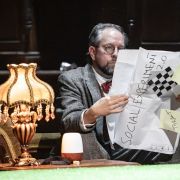
When a director uses an opera’s overture to set up the concept that the following action is all a social experiment engineered by one of the cast, do we end up caring less about the characters? In Orpha Phelan’s staging of Tamerlano for the London Handel Festival, it’s a very real risk. She casts the minor role of Leone as Sigmund Freud, who sets up his players to see what happens. We do care, however, about the singing – especially two outstanding performances – and the truly excellent Academy of Ancient Music under Laurence Cummings.

Phelan and her designer, Madeleine Boyd, make intelligent use of the space in Shoreditch Town Hall. Played in the round, with the orchestra up on the small stage, they use several island platforms in the Stalls, each associated with a different character and era, allowing for swift jump-cuts from one scene to the next. The opera is sung in pithily updated English – Why? Handel composed Tamerlano to an Italian libretto for a London audience at the King's Theatre, Haymarket – with surtitles beamed onto all four walls (until they conked out in the final ten minutes).

He’s an easy target, but must every despot or tyrant in opera productions these days be depicted as Donald Trump? Phelan casts Tamerlano, Emperor of the Tartars (Timur), as the US President, who toys with the defeated Ottoman Sultan Bajazet (Bayezid I) like a mouse because he’s fallen in love with his daughter. On stage, we get all the visual clues of the Oval Office desk, golf clubs, red baseball cap, Big Mac. Countertenor James Laing plays up the bullish Trump persona with an insolent swagger and petulant temper tantrums, so it’s a pity that he was the vocal weak link in the cast on opening night, with wayward coloratura and insecure lower notes.

Greek prince Andronico, also in love with Bajazet’s daughter, Asteria, is cast as a Roman general (Julius Caesar?). The sketch of Salome with the Head of Saint John the Baptist on their artists’ studio island reveals Asteria as Artemisia Gentileschi, Bajazet presumably her father Orazio, although his costuming makes him look more like a Dutch master (Vermeer?). With Tamerlano’s dumped fiancée Irene cast as Jane Austen, Phelan’s production would appear to be a metaphor for Trump’s war waged against the liberal arts. The cast bring her vision off with panache.

Sandwiched between Giulio Cesare (1724) and Rodelinda (1725) in a remarkably fecund 12-month spell, Handel’s Tamerlano isn’t quite in their same class. But in the central role of the defeated Bajazet it contains the first major tenor role in opera, written for Francesco Borosini, whose extended death scene takes place, unconventionally for the time, on stage. No wonder Plácido Domingo elected to make his Baroque debut in this role in Graham Vick’s memorable production. Here, Benjamin Hulett was authoritative and agonised, injecting his tenor with fire in the aria “Empio, per farti guerra”, and great pathos in his death scene in the balcony above the stage.
The classiest singing came from two refugees from English National Opera’s revival of Partenope last autumn. Nardus Williams was born to sing Handel and her pearly soprano shone brightly here as Asteria, captivating the audience. American countertenor Jake Ingbar, with his purity of tone and liquid phrasing, was an equally fine Andronico, both he and Williams bending notes deliciously in the duet “Vivo in te”, the opera’s highlight, accompanied by buttery recorders.

Kitty Whately sang Irene with a soft mezzo and pleasing tone, while Canadian baritone Jonathan Brown made much of his inflated role as puppetmaster Leone/Freud, displaying florid agility in “Nel mondo e nell'abisso”, the additional aria Handel composed for Italian bass Antonio Montagnana for a 1731 revival.
Cummings and the AAM provided essentially a seventh character to proceedings, the strings tempestuous, galloping and balmy in turn, woodwinds bursting with character and a sensitive continuo department. Watching Cummings exuberantly hammering away at the harpsichord like Jerry Lee Lewis playing Great Balls of Fire was a special joy.