There is something very alluring about going to watch junior companies in action. They are recent graduates, brimming with talent and enthusiasm and for the spectator, it’s the delightful prospect of spotting an exciting new face. At Sadler’s Wells East, Acosta Danza Yunior presented an interesting quadruple bill of contemporary works that beautifully demonstrated their individual qualities.

First up was Fuga by Spanish born choreographer Susana Pous. The action took place on a small green patch in the centre of the stage, I would imagine representing grass, freedom and community, with a background soundscape of waves. The thrust of this piece addressed the tragedy of migration in Cuba. Underneath a moon-like sphere (clever lighting design by Pedro Benitez), which occasionally appeared eclipsed, six dancers moved in pairs, sometimes altogether and occasionally as if they were rejecting an individual.
It was immediately apparent that these young dancers have a distinctive way of moving. There was innate strength, moving lithely through space, yet nothing looked forced. There were some very interesting lifts and unexpected outcomes and when all six dancers were together, they moved as one. José V. Gavilondo was responsible for the score which was pleasant enough without leaving a lasting impression. Fuga was a pleasing opener but lacked emotional heft, perhaps due to its brevity.


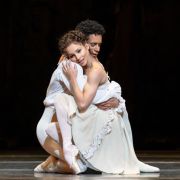
Didy Veldman’s And followed to Arvo Pärt’s Fratres. She claims she had always found the music a source of inspiration and it was obvious from the start that this powerful duet was vividly expressed because of it. Every movement mirrored the changes in tempi. Moods swung wildly from seeming tenderness to rough antagonism.
Even more interesting was the equality in the partnership. This wasn’t about the man manipulating the woman. It was serious give and take. A highlight was the quickfire hand and arm gestures towards the end, where the two dancers had endless physical conversations that ground to a halt mid-sentence. Hands stopped short of touching – very inventive. Maria del Carmen Pantoja and Ernesto Muñoz were a fantastic foil for one another.

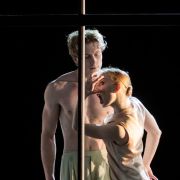
Kit Holder’s Capriccio to music by Joseph-Marie-Clément Dall’Abaco made a huge impression when I first saw it at the Linbury International Draftworks in 2025, possibly more so than anything else on that particular programme. The same cast, Paul Brando and Alexander Arias, delivered the goods again.
Inspired by René Magritte’s series of paintings titled The Lovers, perhaps it is the sheer simplicity of the images: lovers with their heads shrouded in white; what we believe is closeness and intimacy; what we are actually concealing – that makes it work so well. The piece began with the heads covered, then jumped to the two men exploring the dynamics of their relationship without the covers. Surrealism fascinates, and so did this. Stunning dancing and intense communication through movement. I wrote in my notes simply: love it.

Juliano Nunes’ Mundo Interpretado (Interpreted World) closed the programme. The stage was adorned with an installation by Glenda León, water lilies hung from the flies, all pale and pure until a deep red one dropped in a change the mood. The factsheet suggested that Nunes was taking us ‘on a journey from general sentiment to the spiritual essence’. Erm? I might have missed something. Lighting (Benitez again) depicted the various shifts in moods and partnerships.


The dancing was very good indeed, incredibly ‘together’ musically and with a seemingly good rapport between the cast of six. Gavilondo’s music (lots of pipes) was efficiently used in a series of almost commercial looking episodes of dancing. Best sections were when the ensemble were together, with a jazzy feel. When the lighting turned red to match the red water lily (singular), a duet ensued that was more intense, less contented, sometimes uncomfortable.
When the lighting brightened up, another much happier duet supervened. This time with Heidy Nuñez on pointe. She’s a lovely dancer but the introduction of pointe work at the eleventh hour was remarkably incongruous. Suffice to say, in spite of a stage full of potential greats, not all the choreography felt ‘enough’ or indeed ‘right’ for the company.
[

Perhaps part of my bewilderment was down to an inadequate freesheet (no programme) that did not list all the creatives or individual casting, nor even the official running order which left us all somehow wondering exactly what was coming next. Something to think about for the future.