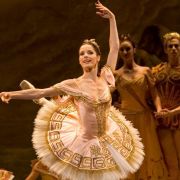
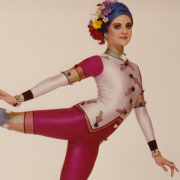
Female choreographers used to be a bit thin on the ground but, it seems, no longer – at least, not here in Scotland. No sooner had we recovered from Aszure Barton’s stunning Mere Mortals for San Francisco Ballet in the Edinburgh Festival than Scottish Ballet came up with a thrilling new double bill, pairing a revival of Crystal Pite’s classic Emergence and relative newcomer Julia Cheng’s Entress.

First off, and getting its world premiere here, was Entress, its title taken from an old Scots word meaning not just ‘entrance’ but ‘the right to enter’. This may have been Julia Cheng’s first real encounter with a major ballet company (her training was in hip hop and street dance) but she’s no stranger to the stage, having been award-nominated for her West End work on Cabaret and Fiddler on the Roof. Entress showed her sure grasp of theatricality.


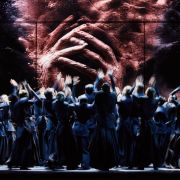
Designer Yann Seabra gave us a bare stage, and a hanging net-like structure. A woman – the Chinese creative goddess Nuwa (Rishan Benjamin) – turned and turned, her swirling black cloak echoing the net above. As she sat in a corner of the stage, a group of black-clad figures came crawling towards her. Another woman, identified only as ‘The Protagonist’ (Kayla-Maree Tarantolo) emerged from the group, angry or in pain, arms swiping the air: alternately absorbed into the crowd or set apart from it, she seemed to be constantly trying to escape or to make appeal to her companions. As the percussion rose to a climax she disappeared into a pit at the back of the stage – a breathtaking moment.

The group moved in rhythmic waves, crawling, sometimes lying motionless on their backs, legs in the air. A Messenger (Yipeng Xu) appeared, his quiet dignity failing at first to force a reaction from the group but gradually winning them over. As the group swept off stage, the Protagonist reappeared and, after a quiet solo, found herself caught in the descending net, comforted by Nuwa. As the net parted and fiery clouds erupted in the background, she reappeared, black clothes gone and, like the rest of the group, now half-clothed and hippity-hopping their way to freedom, cello and strings replacing the violence of percussion, and the net rising again shaped like wings. Peace and resolution at last.

Lest description should suggest a narrative, however, this wasn’t really the aim: Cheng offered more a succession of snapshots generated by her anger and grief at the endless conflict and destruction at loose in the world. Off stage, her regular collaborator percussionist Beibei Wang dominated Isobel Waller-Bridge’s score. Glimpsed constantly in movement in the orchestra pit, she seemed to have more arms than an Indian statue as she leapt from drum to drum to crashing cymbals and back. Entress was way more than a promising debut.


Hard to believe now that back in 2009, when Crystal Pite created Emergence, she was also a newbie among major dance companies. For this revival of the work first danced by Scottish Ballet a decade ago she’s done some tweaking but it remains an intriguing and engaging glimpse into a parallel world of insects, birds and other organisms whose lives embrace groups and outsiders, acceptance and rejection. In this sense it sat well with Entress but the choreography was a world away. In what we now think of as ‘typical’ Pite, a stage full of flowing shapes moved in well-drilled straight lines like ant colonies, giving way to girls tap-tapping pointe shoes like claws; creatures swarmed and scattered; every bit of the body was used, down to splayed fingers that might have been stings. And if you thought swans were scary, you ain’t seen nothin’ yet… This was a great piece of programming: long may it stay in Scottish Ballet’s modern repertoire.