

Created in 2017, this was the second of three interpretations of Henrik Ibsen’s plays, made for Norwegian National Ballet by Marit Moum Aune, sandwiched between Ghosts (2015) and The Wild Duck (2024). In 2027, Aune is due to become director of Oslo’s National Theatre, which attests to her primary skill in stage direction. Her choreography was developed in collaboration with the dancers who created the roles, while Kaloyan Boyadjiev took charge of the group movement.
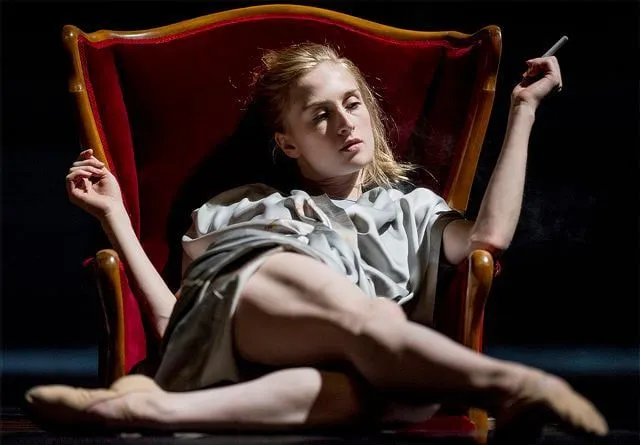
Written in 1891, Hedda Gabler was a century ahead of its time, dealing with the psychological complexity of a woman who is trapped in a boring marriage and frustrated at not living her adult life to the manner born. Ibsen provided a key to her character and status in the title since it retains her maiden name even though she is married throughout the play.
The intensity of this production takes the physicality of ballet to another level, emphasised further by a violent and erotic grittiness that reflects the literary realism in Ibsen’s writing. At the centre of everything, in the title role that she created, was Grete Sofie Borud Nybakken. It was onstage after the first night revival, six years ago, that she was promoted to principal dancer.
In theatre, Hedda Gabler is a role seen as a female equivalent to Hamlet in terms of its intensity; in ballet, it is as all-consuming as Rudolf in Kenneth MacMillan’s Mayerling. There are countless highly physical duets with multiple partners, and the expressiveness and calculated scheming of her character is of vital narrative significance, for which Nybakken delivered finely nuanced meanings a-plenty. She bares everything (literally) in her pursuit of artistic excellence. One has to be Norwegian to fully appreciate the strength of Nybakken’s portrayal, but judging from the many Norwegians around me, she clearly enjoyed universal approval.
Nybakken’s command of her character was given a jump-start since we first encountered Hedda as a young child portrayed with haughty confidence by Sara Bringebøen Jensen. The bullying of her young schoolmate, Thea Elvsted, played sympathetically by Michelle Hammersland, was uncomfortably nasty. As the adult Thea, Hana Nonaka Aillon was touchingly nervous and empathetic, in complete contrast to her tormentor.
Aune’s directorial skill gave a memorable opening scene where young Hedda steps under the safety curtain, from which pop eleven pairs of male legs, hanging down in military uniform and leather boots. Jensen gives way to Nybakken’s Hedda so that she danced with the soldiers and played with her father, General Gabler (Kristian Alm), evidencing her upbringing as a tomboy, enjoying a strong militaristic bond with her father and inheriting his love of guns.
While Nybakken and Alm remained in the roles created on them, the rest of the cast is new. Douwe Dekkers brought anguish and poignancy to the tragic and somewhat depraved Eilert Løvborg, once infatuated with Hedda. Martin Dauchez was appropriately low-key as Hedda’s bookish, boring and compassionate husband, while Erik Murzagaliyev was quite the opposite as the lecherous Judge Brack. It would be hard to imagine a more physically abusive duet than his final pas de deux with Nybakken, in which Brack is effectively blackmailing Hedda into having sex with him.
Gina Storm-Jensen (much missed at The Royal Ballet) was both beautiful and scary as the black-eyed Aunt Julie, circling the stage in two menacing, solos of stretching, stalking intensity. Her initial appearance from a bed suspended several metres above the stage was an interesting coup de théâtre. And a word for Veronika Selivanova who portrayed the sad courtesan, Diana, sharing Løvborg’s final, drunken and abusive duet before he accidentally shoots himself in the crotch with the gun that Hedda gave him as encouragement to kill himself in a “beautiful death”. Unfortunately, it didn’t turn out that way.
Even Børsum’s imaginative set designs utilised both above and below stage with suspended furniture and frequently used traps. The fourth wall was broken by entrances and exits coming from steps up from the orchestra stalls, all pinpointed in the precise lighting designs of Kristin Bredal. The costumes by Ingrid Nylander ranged from historically accurate daywear of the late nineteenth century to surreal fantastic creatures in the bordello scenes, wearing fish masks and top hats.
The eclectic, episodic score by Nils Petter Molvær was always in perfect alignment with the many moods of the dance theatre, from the cool poignancy of solo piano to thumping electronic rhythms. Molvær himself provided the live music, skirting the darkened stage periphery with memorable trumpet solos.
One must credit artistic director, Ingrid Lorentzen, for having the vision to celebrate Norway’s literary giant through this process of innovation by collaboration and in utilising this approach so completely, the team has reaped the considerable achievement of successfully presenting Ibsen without words.
Graham's trip was funded by Norwegian National Opera and Ballet
