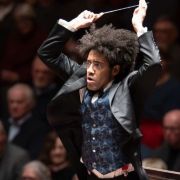
The Royal Concertgebouw Orchestra rolled out the red carpet for Venezuelan conductor Rafael Payare this week. Within hours of arriving in the Netherlands, he was whisked into TV studios for an interview on Dutch classical music magazine Podium Klassiek. Much was made of his introduction to classical music and progress through El Sistema, allowing discussion of his time as principal horn of the Simón Bolivar Symphony Orchestra under Gustavo Dudamel, one year his junior. Would Payare win the hearts and minds of these seasoned Amsterdammers with his interpretation of Shostakovich’s Tenth Symphony and give us a performance to remember?

All started well as Sofia Gubaidulina’s Fairy Tale Poem, based on a Czech tale about a piece of chalk, hinted at the playful nature of its young owner tumbling downstairs ready to share its beauty with the world. Jazzy double bass pizzicato, florid piano fragments and glacial strings suggested the child navigating Prague’s wintery frozen lakes while the vibraphone and harp added a very children’s television flavour.
A triumphant orchestral opening to Frank Martin’s Violin Concerto, last performed by the RCO in 1967, evoked a very different mood. Frank Peter Zimmermann’s Ariel from Shakespeare’s The Tempest, on whom the work was inspired, seemed rather shier than the traditional image of a mischievous spirit wreaking havoc where‘er he treads. In Zimmermann’s hands, Martin’s lyricism entranced while his fluid bow arm created openness and honesty in his storytelling. As expected, a concluding calm transported thoughts beyond worldly worries. An evocative conclusion to the Andante led nicely into the Presto where mercurial Ariel chased and taunted his earthly rival, Caliban. The RCO and soloist produced music of the finest quality, but all felt a little underwhelming. Performing such a neglected work fifteen times with seven different conductors in a short space of time is an inspired project. Only time will tell if Martin’s oeuvre becomes an audience favourite. Two lengthy encores, including a rather scrappy Grand Caprice on Schubert's Der Erlkönig, left all on a high.
A dark and ominous opening to Shostakovich’s Tenth boded well. Out of the depths emerged a heavenly clarinet – a beacon of hope in Shostakovich’s torrid land. Payare deftly evoked Stalin’s very Russian landscape completely devoid of hope, even if his gestures on the podium proved to be distracting. Most unusually, the lower brass ensemble wavered. Something was amiss. The woodwinds were having fun, but again, entries did not always speak as one. The piccolo’s glacial chill however, saved the day. Not a flutter to be heard – pure magic!
Setting off apace, the Allegro’s military snare drum showing no mercy was the highlight of the evening. As we entered the Allegretto, the horn implored, the tam-tam shimmered, the cor anglais meandered, bassoons chuntered and oboes questioned before a refrained marching band took hold and a frantic race towards Stalin’s social realism was met by a rather protracted retreat. As the woodwinds in turn offered rays of sunshine, the bassoon promised a better tomorrow. Uncharacteristically though, balance wavered in the finale and, as in previous movements, the overarching line remained vague. This, however, was still very much a performance to remember.