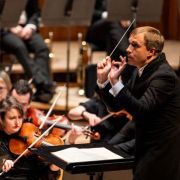
Nearly five years at the helm of the Royal Philharmonic Orchestra for Vasily Petrenko and, based on this stunning performance of Shostakovich’s mighty Tenth Symphony, all is well. With such a mammoth second half, it was perhaps inevitable that Beethoven’s lighter First Piano Concerto and an unfamiliar work by Galina Ustvolskaya would be rather overshadowed, yet both of these yielded strong playing from orchestra and soloists.

Ustvolskaya, a pupil of Shostakovich’s, was also known as “the lady with the hammer” owing to her intense blocks of sound and extreme dynamics. The Dream of Stepan Razin, using a Russian folksong text, tells the story of a legendary 17th-century Russian folk hero. So far, so acceptable to the Soviet regime. Yet Ustvolskaya’s setting for baritone and orchestra, whilst containing folk-infused melody, is full of dark brooding and imaginative orchestration, particularly in the use of the celesta and harp. British-Ukranian baritone, Yuriy Yurchuk had a rich tone in his lower register and declamatory passion at the top. The more detailed orchestral textures obscured his middle range in places, but his intensity of expression was impressive throughout, and Petrenko and the orchestra highlighted the score’s individuality well.
Benjamin Grosvenor’s understated yet commanding performance of Beethoven’s joyful Piano Concerto no. 1 in C major was full of sprightly articulation combined with contrasting expression. Petrenko marshalled the RPO with finesse, although the strings section was on the large side, despite nimble delicacy from its players. Grosvenor’s encore, a watery Moszkowski Étude, was a rippling delight, his fingers here, as in the Beethoven, moving effortlessly and without any unnecessary gesturing.
Stalin’s death in March 1953 spurred Shostakovich on to complete his Tenth Symphony. Is the second movement a depiction of Stalin himself? As ever with Shostakovich, nothing is that straightforward. There is, however, no getting away from the raw violence in the downright scary Scherzo, and aside from moments of third movement lyricism and trademark cartoon-like scurrying in the outer movements, it is an intensely visceral work.

The RPO were on fire, with power and intensity combined with electric precision at pace, and faultless solo work from woodwinds and horns. Petrenko is elegant to watch, even at the wildest moments, yet his control of dynamic build-ups and slow accelerandos were as sharp as a knife. The brooding opening, with the solo clarinet, flute then bassoon worrying and winding around over the macabre lower strings was followed by one of those build-ups, terror breaking out in string surges leading to relentless, thunderous crashes, surely exhausting for the violins (and this was just the first movement!).
The Scherzo was indeed violent, with fearsome stabbing from Petrenko, and the ominously slow-moving brass against the frightened rapid chase music in the rest of the orchestra surely had more than a whiff of fleeing in terror from the tyrant. The third movement is an attempt to unify Shostakovich’s personal D-S-C-H motto with another motto, ‘Elmira’ (after a pupil, Azerbaijani composer, Elmira Nazirova). While this allows for some lyricism, particularly for the solo horn who first introduces Elmira, Shostakovich ends up dominating proceedings with his relentless D-S-C-H. Brooding returns at the opening of the finale, and here the principal oboe’s yearning lament was followed by an even more mournful, crying turn from the bassoon. The clarinet launched the strings off into pacy skittering, and then all bets were off, with Shostakovich's musical monogram hammered out relentlessly. Petrenko drove on through to a fantastic finish, with even the timpani bashing out that D-S-C-H motto, as if Shostakovich was finally able to say, “I will not be silenced”.