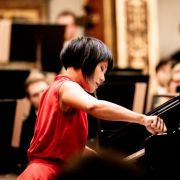
There are few pianists alive who generate quite the electricity of Yuja Wang. But Friday's concert with the Wiener Symphoniker and Chief Conductor Petr Popelka offered something beyond the expected virtuoso fireworks: some of the finest playing I have heard from this orchestra in quite some time. The evening juxtaposed two spectacularly demanding 20th-century piano concertos with Schumann's Second Symphony, a programming choice that moved from percussive modernism and almost superhuman virtuosity to Romantic introspection and exuberance.

Wang, resplendent in red, seemed to arrive at full voltage before the orchestra had quite caught up. Bartók's First Piano Concerto, with its hammering repetitions, jagged syncopations and constantly shifting rhythmic relationships, might have been written expressly for her. Her fingers seem made of steel, her left hand capable of extraordinary power, yet there was nothing indiscriminate about the playing. The thundering octaves were astonishingly precise; complicated polyrhythms emerged with almost insolent ease. Even the sparse, unsettling exchanges between piano, woodwinds and percussion in the Andante retained their rhythmic electricity. Wang appeared almost impatient to get on with it, a force of nature whose extraordinary command makes the technically impossible look not merely achievable but absolutely joyful.
Barber's Piano Concerto offered a fascinating counterpoint. Its angular, dissonant opening movement gave Wang ample opportunity for both muscular virtuosity and expansive lyricism, but the Canzone was a revelation. The woodwinds, whose ensemble sound has become exceptionally refined, were exquisite here, their eerily beautiful melodies suspended over delicate harp textures. Wang responded with playing of remarkable sensitivity, revealing a lyrical generosity sometimes eclipsed by her more explosive gifts. Then came the finale, a ferocious, asymmetrical toccata in 5/8. The original soloist, John Browning, famously persuaded Barber to revise passages that were effectively unplayable at the prescribed tempo. Wang clearly never received that particular memo.
Three encores followed, each greeted with extraordinary enthusiasm: Brubeck's Blue Rondo à la Turk, Kosma's Autumn Leaves, and Márquez's Danzón no. 2. The concertos demonstrated her phenomenal technical command, but the encores showed the breadth of her stylistic personality. Her rendition of Autumn Leaves, in particular, was breathtaking: supple, atmospheric, insanely virtuosic and effortlessly expressive. About the only moment Wang gives cause for concern is during her bows, whose violent exuberance makes me nervous that she might knock herself unconscious one day if she gets too close to the piano.

After the interval, both the audience and the orchestral forces had thinned somewhat, regrettably, because Schumann's Second Symphony offered a different kind of revelation. With Wang gone, one could fully appreciate Popelka's extraordinarily engaged, physically expressive conducting and the responsiveness of the musicians. Every gesture appeared purposeful, every transition carefully sculpted, but nothing felt mechanical. The orchestra seemed unusually alive, visibly invested in the music and in one another. I have occasionally found the Symphoniker's louder playing rather flat and hard-edged, despite their excellent pianissimos. Under Popelka, something seems to have shifted and there was a newly grounded warmth and resonance to the fuller orchestral sound that served Schumann's music beautifully. The strings moved with remarkable unanimity, particularly through the quicksilver runs of the Scherzo and the propulsive finale. The Adagio espressivo was lovingly shaped without becoming overwrought, its long melodic lines unfolding with genuine tenderness.
Schumann's Second has never been among my favourite symphonies, but this was a persuasive, beautifully prepared reading, full of rhythmic vitality and carefully judged contrasts. More importantly, it revealed an orchestra playing with exceptional collective commitment and an increasingly distinctive sound. The audience may have come primarily for Wang's fireworks — and rightfully so — but those who stayed for Schumann were rewarded with something equally valuable: the unmistakable sense of an orchestra and conductor finding their fullest expression together. A memorable evening, not only for its virtuosity, but for its variety and substance.