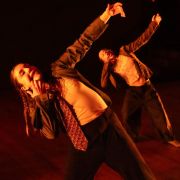
In search of respite from future-tripping, I fled last week to the Future Dance Festival at New York’s iconic 92nd Street Y to trawl the imaginations of the next generation – because when they inherit the planet, they will have to fix much of what we’ve smashed.

Now in its fifth year, the Festival centered dances by women this season: a line-up of eight dance films, 14 dances presented live – and two more works that remained unseen because their creators, based in France, could not get US visas. (Add visas to the list of things that need fixing.)
Taking aim at the patriarchy, Savea Kagan made Glass Ceiling for Jacque Forman and Caroline Clarke, who danced a splintering identity to a collage of Donald Trump’s demeaning remarks about women. His reference to “deeply troubled women” resounded like a chorus against an ominous electronic score. In blazers, one strode in with heels clicking while the other crawled on with hands thrust into her stilettos. Their sinewy interplay was cheeky, comic and increasingly desperate, looks of alarm punctuating the fragile levity.

Two works reflected magically on identity and legacy:
In Manikya, the Indian American dancer Jeevika Bhat leaned on her classical Odissi training, her fingers sculpting delicate filigree in the air. Water-like motion and crisp footwork that set off shimmering ankle bells felt deeply classical, yet bold traveling jumps and sustained extensions that pulled the body from its center hinted at contemporary influences. This paean to the goddess Shyamala, exemplar of wisdom, speech and music, was set to a sublime classical song. In a kind of surrender, she closed her eyes, the dancer giving way to the deity.
Imani Gaudin made her own music in bury me in new orleans, humming, finger-snapping and chanting the occasional lyric (“Lord, you are good to me.”) In a plain white robe, she wandered the stage as if in a trance. She read an entrancing poem about her mother, “with the sun behind her eyes”, the phrase her mother once used to describe her as a child. The calming invocation of her mother carried a similar sense of the divine.

Five imaginative works conjured forces that bind us to the earth:
Laura Coe, her practice informed by investigations into her Chickasaw ancestry, made Body as Archive, her swirling, stretching and contracting movements in a rust-colored shift circumscribed by an elastic cord that connected her long braid to her toes, looped over a thumb. A Shostakovich fugue rippled like water. The flexing arcs of the taut cord evoked the boundaries of a nation through forced migrations along vital waterways.
Lu Wang shrouded herself and Yuxi Liu in a seemingly endless length of red gauze, their bare arms slicing the air as they manipulated the fabric. They glided in tiny steps with it pooled around their ankles. Abandoning the material, they moved expansively, ponytails flicking. This gravely cryptic dance, uncompromisingly titled Truth and set to the mournful noodlings of Max Richter, evoked waterways or migratory flyways disrupted by human intervention — or a river of blood through a conflict zone.

In The Flock, a film by The Âme Project’s Idy Vandepas, dancers appeared on Washington state’s magnificent Ruby Beach, thunderstruck by something off-screen. Maneuvering into defensive formations with cautious juddering steps, twisting heads and sharply lifted elbows, they hovered uncannily between avian and human form.
In FLOW – filmed in the woods and rushing waters of an upstate New York trout stream – Shoko Tamai’s entirely human dancers enacted an enigmatic slow-motion ritual, as if trying to heal one among them who was suffering. In the final freeze frame, they were caught bounding exuberantly through the woods.

Dancer-choreographer Kathleen Dalton was filmed idly surveying a field on Governors Island, a former military installation in New York Harbor, in DREDGE: Above Us. The title references the scarring of the marine environment during the decades-long military expansion. At ground level, the roving camera located Dalton through weeds, rescaling her against the semi-wild landscape as hard light flattened tonal contrasts, her figure sometimes merging with the terrain.
In these communings with nature, the body seemed to find a fragile equilibrium. Elsewhere, pain, loss and loneliness lingered unresolved:

Miho Ryu, undergoing cancer treatment, could not appear in person. She appeared on video in I’m still in the process of making peace with myself, though …, dancing her frustration with a body that had let her down. The contrast between fractured and flowing movement was powerful.
Cristina Camacho’s Good Grief, seen live at last year’s festival, returned as a vividly wrought film. Dancers fled a crumbling classroom while poignant snippets of old home videos were layered onto the highly charged choreography. Dancer Jada Ballard tried to bend the fiery ensemble to her will as old memories haunted her.
Live on stage in Jessee Leigh Robinson’s For Whom the Bell Tolls, b-boy Eliud Xavier Melendez wove through an ensemble of tappers as J. Cole and Kendrick Lamar rapped of interior crises. The tappers quivered one foot in a rapid metallic vibrato, like a warning. Melendez threw himself across the floor, spun on his back and mimicked the tap movements while anchoring one hand to the ground – this virtuosic display of how techniques can illuminate each other also conjured profound isolation.

Joy abounded in works unconcerned with the state of the world or crises of the soul:
Rylan Joenk’s PEARL DIVER staged an altercation between a dancer in a floral swim cap and another in a latex goldfish mask while unruly conspirators in the pleated skirts and ties of schoolgirls rocked out to Animal Collective’s feral noise.
Madeleina Abrahams, Grace Delstanche, Maya Fish and Mina Meier – barely out of Trinity Laban Conservatoire – documented a carefree night on the town in the film BUNNY. They hit a seedy underground club and a fried chicken joint before scampering through a park, their white dresses glowing in the dark. In bright sunshine, the dresses hung drying on a laundry line, still stained from their adventures. The film is a pastoral tempered with a hint of violence: their world is beautiful but not benign.
The world of 3, 2, 1… GO was another kind of pastoral. To an “exercise counting” soundtrack that counts to 50 in two-second intervals, Grace Yi-Li Tong and Stephanie Shin devised a series of goofy exercises for Shin and Paulina Meneses to repeat and accumulate. But some undiagnosed breakdown caused the system to fail, sending the dance into meltdown. Shin and Meneses salvaged what they could, the audience strangely invested in their success. When a voice announced, “Amazing! You did it!” they glowed and bobbed gently with satisfaction.