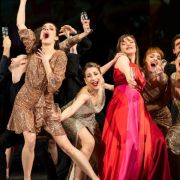
In collaboration with the Salzburg Festival (where it was staged in 2021), the first ever staging at the Teatro dell’Opera di Roma of Il trionfo del tempo e del disinganno feels like a pearl, not only for its rarity, but also for the absolute beauty of the work, composed by Handel at just 22 years of age during his time spent in Rome. The libretto shows all the culture and refinement of Cardinal Benedetto Pamphilj, a passionate patron of the arts, strong admirer and Handel's host in Rome.

Gianluca Capuano gave a vivid reading of the score, leading the Orchestra del Teatro dell’Opera appropriately integrated with first class specialist Baroque musicians. Baroque violin bows were also used. This was possibly the most “Baroque” sound I’ve ever heard in this theatre. However, Capuano seemed to have a bias towards the instrumental score, while his choices for the vocal parts were sometimes baffling. An example was the aria of Beauty (Johanna Wallroth) “Un pensiero nemico di pace”, where the exciting storm in the violins was unfortunately not matched by a meaningful phrasing of the verses, and the beautiful aria lost its power. Similarly, the aria of Pleasure (Anna Bonitatibus) “Tu giurasti di mai non lasciarmi” was sung so fast that it lost most of its depth. The opposite, instead, happened to the most famous aria “Lascia la spina,/cogli la rosa”, which was sung very slowly.
Unlike most of Handel’s oratorios, this one doesn’t have its source in episodes from the Bible, but revolves around four timeless allegorical figures: Beauty, Pleasure, Time and Disillusionment. Director Robert Carsen makes all the contemporaneity of these themes even more explicit by setting the scene in a TV talent show, in an age where screens big and small amplify the eternal vanity of human nature. Beauty is the winner of the contest, and she indulges in earthly Pleasure until she is faced with the mirror of truth shown to her by Time and Disillusionment and decides to change her ways.

Gideon Davey’s set and costumes, especially in the first part, emphasise the kingdom of Pleasure: a brightly lit TV set, sparkly clothes and disco balls. Rocafilm curated the video contributions showing, at the beginning, the full cast partying in an actual historical location (Palazzo Farnese in Caprarola). A nightclub dance to the tune of organ and harpsichord proved a memorable and surreal scene, with a DJ representing “un bel giovinetto” (a handsome young man), Handel’s alter ego in the librettist’s intention. Really, whatever it takes to bring opera closer to the younger generations; but it worked! Rebecca Howell led the choreography of several dancers on stage. In the second part, following the spiritual evolution of Beauty, everything becomes more rarified and abstract, and the lighting – by Carsen and Peter Van Praet – plays a more central role, with semi-darkness being prevalent. Another scenic highlight was the sudden appearance of a huge mirror – the mirror of truth – in the background: a tarnished, slightly uneven surface reflecting… the audience in the theatre! A simple but impressive trick.

The vocal side, on the other hand, took almost all the first part before really impressing the audience, when countertenor Raffaele Pe (Disillusionment) won the first roars of applause for an intense and technically perfect interpretation of the touching aria “Crede l’uom ch’egli riposi”, requiring substantial breath control. His other showpiece aria, “Più non cura/valle oscura” had the same effect. Although a countertenor felt a rather unusual choice for the role of Disinganno, which is normally played by a contralto, it turned out to be an equally effective one, giving a more abstract nuance to this character.
Similarly, instead of a soprano, for which the role is written, Piacere was well sung by mezzo-soprano Bonitatibus. “Lascia la spina” was irresistibly moving and the most applauded piece of the evening, maybe precisely because of the slow tempo which traced its more famous contrafactum, “Lascia ch’io pianga” from Rinaldo. A sly choice on the conductor’s side? Young Swedish soprano Johanna Wallroth was a very fitting “Beauty”. Her stage presence was impressive for the intelligence of her interpretation. Tenor Ed Lyon, playing Time with a warm timbre, shone in his duet “Il bel pianto dell’aurora” with Pe, when they slowly crossed the auditorium floor on each side for a spellbinding moment.

With the usual caveat about staging oratorios, Carsen does the best possible job with it, with the double achieved goal of “filling the stage” and shortening the three centuries distance between us and the year of the work’s composition (1707). This was an evening of refined musical and theatrical delights, albeit somewhat unevenly distributed.