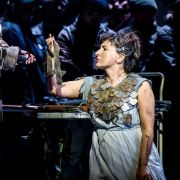
Bellini’s Norma is an opera that lives or dies by its heroine. It’s one of those great soprano roles: emotionally, physically and spiritually punishing, demanding not only vocal stamina but tragic grandeur. The role has inspired radically different interpretations across generations from Maria Callas emphasising Norma’s fierce dramatic intensity to Joan Sutherland revelling in the beauty of Bellini’s bel canto lines. Tonight Georgian soprano Salome Jicia tried a combination of both; fierce tension mixed with floating vulnerability, largely succeeding. Sadly, Irish National Opera’s production sheds little additional light on the work itself.

Director Orpha Phelan relocates Norma to a dystopian post-apocalyptic world, but her concept sits awkwardly with the libretto’s constant references to Druids, Roman occupation and sacred ritual. The production never fully reconciles these elements, leaving the staging concept feeling imposed rather than organically connected to the drama. By negating the religious element altogether, it cuts the entire dramatic tension of the opera, in particularly making Norma’s final sacrifice strangely inexplicable.
Madeleine Boyd’s sets and costume designs reflect this post-collapse landscape with dark monochrome jeans and jerseys for the Gauls and Romans, the latter distinguishable by their gaudy red mohawks. The cluttered assemblage of fences and discarded furniture never coheres into a convincing dramatic world. Bellini’s invocations of sacred ritual and political oppression consequently feel oddly detached from what appears on stage.

Musically there was much to admire. From her first entrance, Jicia conveyed genuine emotional commitment. She sang “Casta Diva” with notable poise and sensitivity, impressing most with the clarity of control of the pianissimo and melting delicacy of the lines of filigree. Bellini sets the tessitura punishingly high, yet never did it seem forced for Jicia. At times, some of the highest notes were attacked rather than fully floated.
In Act 2, it was hard to reconcile convincingly the previous meditation of the killing her own children with her noble sacrificing of herself for Pollione, yet Jicia was able to convey the emotional complexity and turmoil satisfactorily. Her dazzling coloratura never obscured the character’s anguish. Particularly affecting was her relationship with Adalgisa, Siobhan Stagg, who brought a lighter, more silvery timbre, her pure tone and restrained vibrato lending clarity and freshness to the line. Her Act 1 aria was finely controlled, the upper register opening effortlessly. In their Act 2 duets arias, Jicia’s larger voice naturally and consistently dominated, yet there was no doubting the sincerity of affection on display from them both.

The role of Pollione poses a challenge; dramatically weaker than the women, it can often feel one-dimensional as a character. Mario Chang never fully conveyed Pollione’s divided loyalties or emotional urgency. There was no chemistry between him and Adalgisa and no fraught emotions with his former lover Norma. Vocally, his middle register often lacked freedom, although the upper range carried greater assurance, particularly in the final scenes.
Conductor Maurizio Benini ensured the momentum was always pressing forward with lively tempi and dramatic dynamic contrasts. He balanced his orchestral forces well, while always allowing the singers, especially Jicia, to shine even in the most dramatic of moments. The Irish National Opera Chorus was in fine voice. Whatever the limitations of the production’s grungy visual aesthetic, the choral singing combined clarity with grandeur, sustaining a genuine sense of communal tension between public ritual and private emotion.

Ultimately, musically impressive though it often was, Phelan’s production never found a convincing dramatic world for Bellini’s tragedy.