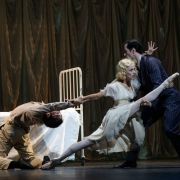
Before we get to Ballett Basel it’s worth saying a few words regarding the venue for this mixed programme, the Cologne Opera House. Having lived in Germany for six years, this is my first time reviewing here and with good reason. The Opera House has just reopened in September after a mammoth closure of 14 years! The venue closed in 2012, originally scheduled to reopen in 2015. Needless to say, events were somewhat delayed, with a grand reopening taking place for Der Rosenkavalier two weeks ago, with the project’s estimated cost coming in at €1.5 billion. Ballett Basel represents the first dance offering of this new era.

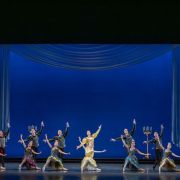
Entitled Drei Meisterwerke (Three Masterpieces), the title is certainly fitting of the first work of the evening, Jiří Kylián’s Bella Figura. Danced with delicate physicality by an ensemble of just nine, but it feels like more. Blurring the lines between performance and reality, the dancers warm up on stage as we take our seats. The tight fitted structure of those familiar burgundy corsets with grey sweatpants and other loose rehearsal wear. There’s an inviting informality about it.


Petite Chisato Ide was striking in the first duet with quivering feet and flexed wrists. Indeed the whole ensemble showed the contrast between the brittle and angular moves of the first section and the sensual, vulnerable emotions of the second. The image of the stage curtain closing in around the dancers is slick and atmospheric. The shift to swaying hips and the bare chests with billowing red skirts to Giuseppe Torelli’s baroque Concerto has a regal authority. Two women are left centre stage, they shed their skirts, their limbs now soft and fluid as they speak a wordless conversation, heavy and melancholic.

The ensemble coped well with the physicality and understated drama of it all, although some of the couples could have been even sharper. Ana Paula Camargo exuded calm in the final duet, with a casual shrug of the shoulders to a soundless backdrop, making for a poignant conclusion.
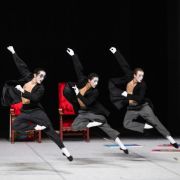
I’ve always enjoyed the work of Hans van Manen and was looking forward to The Old Man and Me, a work I had not seen before. It’s a fifteen minute dance for two created in 1996 for Nederlands Dans Theater.
Broken into three clear sections, we begin with the gravelly tones of J.J. Cale’s song from which the work gets its name. Although visually still youthful, Rosario Guerra brings the necessary maturity to the role of the old man. He initially appears frozen in time with a dead-eyed stare. The relationship between the man and woman (Lydia Caruso) is likely husband and wife but never made explicitly clear. Caruso spends the first song vying for Guerra’s attention. She slinks around seductively, a bit of flamenco, a shimmy, jazzhands, she throws it all before him, but Guerra looks straight through her. It’s a sad image of unrequited love before switching to Stravinsky's exuberant Circus Polka. The pair fall into more jovial galloping and skipping, and there’s a playful energy between them. Guerra’s Old Man seems to have a second wind, but the shift in mood was rather jarring.


We switch again for Mozart’s Piano Concerto No. 23 and there are clear signs of reflection, regret and growing older. There’s some real classical partnering danced mournfully, suggesting their ultimate dependency on each other. It’s deeply thought provoking but I would have liked more chemistry between Guerra and Caruso to make this as emotionally devastating as it could be.
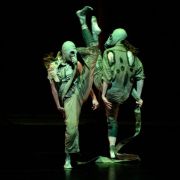
Sadly, the evening did not improve from here. Co-Artistic Director Marco Goecke’s reimagining of Le Spectre de la Rose is left to close. Contrasting in every sense from the light, bright ethereal beauty of the Fokine original, Goecke’s take is an intense, almost aggressive reinvention. Using a twitching, trembling movement vocabulary with a focus on fast and frenetic arm movements.

The cast is beefed up here with additional rose “spirits” who spread rose petals generously across the stage. Floris Puts and Sandra Bourdais take on the leading roles as the Rosengeist and Young Girl respectively. They give it their all; arms flap, bodies bend and snap, there’s endless jumps and hopping and facial theatrics that demand athleticism from every muscle. They dance themselves into a frenzy before collapsing into an embrace. The choreography is certainly unique, however it doesn’t respond to the drama of the score in a satisfying fashion. It’s well drilled and creatively delivered (Michaela Springer’s costumes are a glorious crimson) but overall it’s an acquired taste.
Although mixed in success, the three choreographic voices sit well together in the programme. The company shows great sensitivity and versatility throughout, but it’s Kylián’s haunting Bella Figura that will linger longest in the memory.