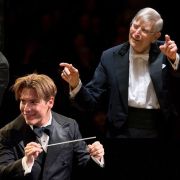
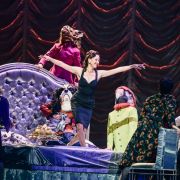
The problems associated with articulating political messages through orchestral music do not seem to get any easier with the passage of time, no matter what form the message-bearer takes. However, that doesn’t prevent composers writing such works and in 2019 Gabriela Ortiz produced Revolución diamantina, a six-movement ballet suite inspired by Mexico’s ‘Glitter Revolution’, a reaction to the perceived epidemic of violence against women. This work, receiving its UK premiere, formed one half of the second of two concerts given by the Los Angeles Philharmonic, under its outgoing Music Director Gustavo Dudamel at the Royal Albert Hall. It was given a rapturous reception.


Actually, there were two rapturous receptions; the first followed the orgiastic ending of the fifth movement, Pink Glitter, which rather detracted from the reflective, soulful finale, Todas, whose hushed utterances were amongst the best things in the whole work. Elsewhere in the suite the orchestra, which included five nests of percussion and the upper voices of the Los Angeles Master Chorale, ran through a string of gaudy material strung out on a line, like fantastic bunting dancing in the breeze. Dudamel was in his element bouncing along to its regional rhythms. Nothing sagged; the instruments that tinkle tinkled and those with thick skins took a good beating. Marshall McLuhan schooled us to regard the medium as the message but, although I listened attentively, I flunked the exam.
In marked contrast, the other work on the programme was Beethoven’s Seventh Symphony. It’s not a piece that has attracted interest for overt – or even benign – political messaging, although there is a lobby that has claimed it for ‘The Dance’, which might be code for a cultural fifth-columnist. Dudamel approached it as a highly-articulated creation whose various parts were marvellously designed. And he knowns it can fly; the opening had enough latent energy to allow it to experience the moment for which the Wright Brothers worked so hard. Once airborne it was kept in motion by propellants comprising a blend of the sonorities generated by stylish playing. In the Allegretto, the woodwinds contributed a liquid-crystal shimmer laid over the mercurial quality of the LA strings. The horns had probably imbibed some pleasure-enhancers, of the recreational kind; they were so relaxed in the Scherzo but by the finale they were definitely on a high.


The main attraction of this concert was a chance to experience, in person and at close quarters, the phenomenon of ‘The Dude’ and the LA Phil. From that perspective it was mission accomplished. However, although the programme was a little on the short side I did not leave wanting more. The intrusion of the audience was no fault of either the conductor or the orchestra, and it wouldn’t have bothered them, but it did have a material impact on the performance. It is to be hoped that we will not have to wait over 20 years until we can hear them again at the Proms.