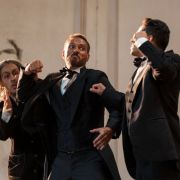
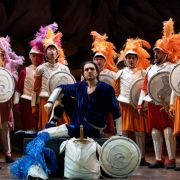
In contrast to the brilliant orchestra, conducted by Daniel Oren, and the excellent performance of Vittorio Grigolo, Luca Del Fusco’s new staging of Charles Gounod’s Roméo et Juliette for the Teatro dell’Opera di Roma feels uninspired. Adopting a monochrome aesthetic, the director moves the action from the Renaissance period to 1943, during an Italian civil war between republican fascists and partisans. His contemporary, abstract take, rather than a realistic period setting of the Romeo and Juliet story, doesn’t work here.

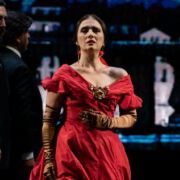
Marta Crisolini Malatesta’s costumes feel out of place. Romeo's sharp suit does not convey his youthfulness, while Juliet’s bridal outfit looks too formal for a secret wedding. Malatesta’s set comprises a background wall with several arched windows, showing in turn (on a screen, with video by Alessandro Papa) different abstract landscapes: a Giorgio de Chirico square, a block of red colour, etc. Occasionally the wall turns from black to a richly decorated period interior. These may be clever expedients for another opera, but not for Roméo et Juliette where, to be pulled into the drama, one requires identification rather than estrangement. Similarly, the technically clever trick of a projection creating another layer on stage, either on the background wall or on the foreground on a transparent panel, is here often used to display amateur quality videos with no artistic depth: the two hands of the lovers touching, a stylised wedding veil signifying also a burial shroud, geometric flowers. Distracting and unnerving.


As for the cast, Vittorio Grigolo truly shone in the role of Roméo, both vocally and dramatically. His phrasing was sensitive and his acting natural and believable, with his secure tenor showing no strain at any point. The exuberance of the role suits his style best and I preferred it to his Cavaradossi or Alfredo. He also had very good French diction, which was not always the case for the rest of the cast, possibly highlighting the need for a French language coach.

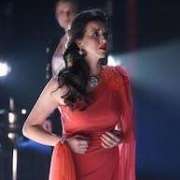
Nino Machaidze’s Juliette grew during the evening. While she did not initially impress, including the opera’s most famous aria “Je veux vivre”, riddled by many an imperfection, her performance improved and she delivered a very good Poison Aria, “Amour, ranime mon courage” which showed her to be more at ease singing in a lower tessitura.
Among the supporting cast, the deepest mark was left by Aya Wakizono in the role of Stéphano. The stylistic anachronism of the character and his aria – a trouser role singing an ornate 18th-century style song in the middle of a romantic drama – didn’t prevent the audience from utterly enjoying a moment of accomplished virtuosity. Another notable character was the Frère Laurent of Nicolas Courjal (doubling the Duc de Vérone), with his pleasing and round bass. The rest of the cast were very good.


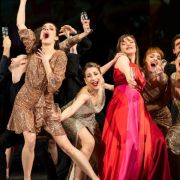
Dramatically, the Act 3 duel scene was really impressive, and the final duet very successful. The ballet, usually contained within Act 4 after Juliette has been told that she should marry Pâris, is here moved to the beginning of the act, performed over the prelude’s music. Added by Gounod in 1888 for a version at the Opéra de Paris in order to adhere to its rules, the ballet feels completely out of place here for multiple reasons: it loses its dramatic meaning (the wedding procession); it is done in a contemporary style which clashes with the period aesthetic of the 1940s setting; and it distracts from the prelude’s music – the same sad destiny of many opera overtures and preludes today, cluttered by stage movement.