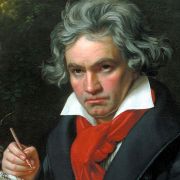
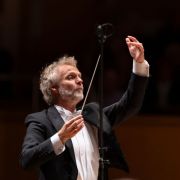
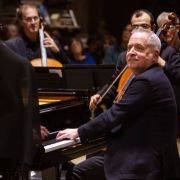
In what feels like a highly enlightened example of inter-institutional musical collaboration – the sort of thing it would be wonderful to see happening elsewhere – concert halls across the German state of North Rhine-Westphalia are collaborating this season to host Igor Levit playing all of the Beethoven piano sonatas. Levit’s Beethoven journey will have stops in Düsseldorf, Dortmund, Essen and Cologne, and it was in Cologne’s Philharmonie that I saw this instalment, five sonatas that ranged across the beginning and middle of the composer’s Vienna career.

This is the first time I’ve seen Levit playing in Germany – Russian-born, he is now a German citizen – and his interplay with the audience was fascinating to observe, almost making the Cologne crowd a part of the performance. His overall manner as he strode on stage was remarkably relaxed, but then he seemed to enjoy creating some mischievous awkwardness as he watched some latecomers move towards their seats, or as he quietly admonished some intrusive coughers. He also seemed to play a game, the rules of which I never quite understood, about when to clap. He got a spontaneous ripple of applause after the huge Largo of the Fourth Sonata, which his manner suggested he didn’t want to encourage, but then he relaxed into it and nodded to the audience while jovially pointing out that there were still two movements to go. Later in the Op.14 sonatas, however, he seemed to find the inter-movement applause quite irritating, and when he announced his encore, one of Mendelssohn’s Songs Without Words he “joked” that “it has only one movement!”


Yet whether this was banter or irritability, his playing sang, most especially in the E flat No. 4 which, the programme pointed out, is Beethoven’s most expansive piano sonata aside from the Hammerklavier. He tackled the opening with thrilling energy, those accompanying quavers straining at the leash like a dog on a chase. He seemed to disappear into the work so deeply that he would raise an idle hand as though to conduct, or shift his feet so that he could attack the keyboard even more vigorously, or even shush himself at certain moments. Who knows whether they were theatrical gestures or they genuinely helped him to focus, but either way, they worked. He brought beatific stillness to the expressive Largo, while the fourth movement combined sunny simplicity with dramatic turbulence, the quiet ending sounding less like a joke and more like a gentle cheerio.
The pair of Op.14 sonatas seemed like quirky twins. Levit brought out the essentially playful nature of No. 9 with a marked dose of seriousness to temper the headlong finale, while the outer movements of No. 10 seemed exploratory and fresh next to the central variations which were almost comically four-square.
Not everything worked quite so well. The overall cantabile feel to the first movement of the F sharp major Op.78 was abandoned in a finale that was so abrupt that it became muddy in some of its runs. The opening of Les Adieux (Op.81a) was taken extremely slowly, perhaps to play up the contrast with a finale that was almost perversely fast, the roiling torrents of notes sometimes tripping over each other in a way that lost the musical line.


It was still remarkable playing, though, and it always oozed character and distinctiveness. We should envy those lucky Rhinelanders – and their enlightened concert programmers – who will get to hear the complete cycle.